
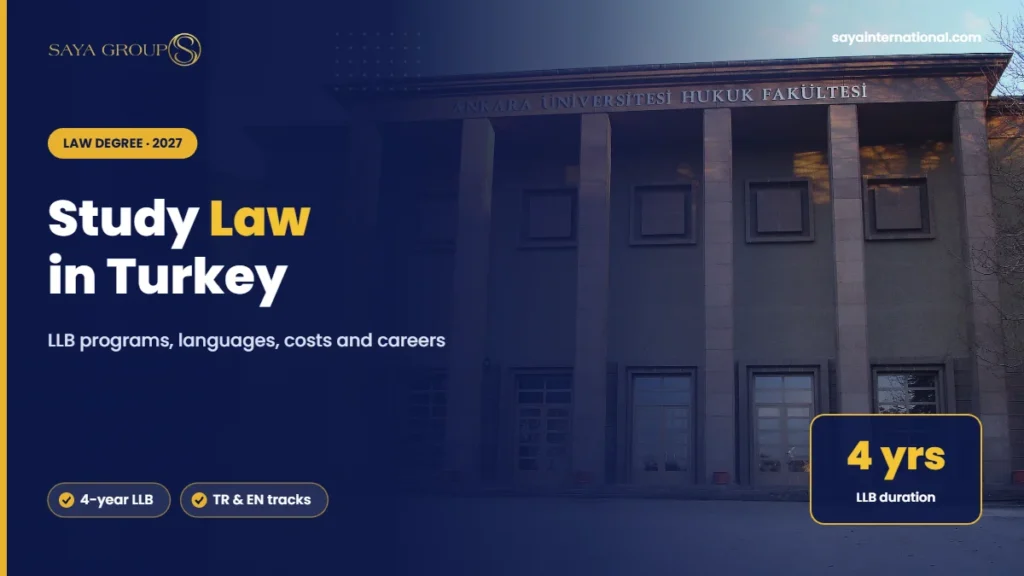

Every year a few dozen of the students who contact us ask the same thing: can I study law in Turkey as a foreigner, and will the degree actually be useful afterwards? The short answer is yes, you can, and for the right person it is a smart choice. The longer answer depends on the language you are willing to study in, where you want to work after graduation and how much you can spend on tuition
Turkish law faculties are old, serious and fairly competitive. Ankara University opened its law school in 1925, and Istanbul University traces its legal teaching back even further. What surprises many applicants is how European the system feels. The Turkish Civil Code was adapted from the Swiss model in 1926, commercial law borrows heavily from German thinking, and a lot of the reasoning you learn will look familiar if you later move into EU or comparative law
Why Study Law in Turkey as an International Student?
The honest selling points are cost, quality of teaching and location. A law degree at a decent state university costs a fraction of what you would pay in the UK or the US, and the faculties in Ankara and Istanbul have produced judges, ministers and academics for a century. You also sit between Europe, the Middle East and Central Asia, which matters if you are interested in trade, energy, migration or human rights work
There is one point we always raise in the first call, because it saves people a lot of disappointment. A Turkish law degree trains you in Turkish law. If your plan is to practise in your home country, you will need to check how your local bar treats foreign law degrees before you enrol. Some countries ask for conversion exams, some ask for extra coursework and a few will not accept it at all
Language of Instruction: Turkish, English or French?
This is the biggest decision you will make. Because the core subjects are Turkish codes, statutes and court decisions, the vast majority of undergraduate law programmes are taught in Turkish. State universities usually expect proof of Turkish at around C1 level, and most international students reach that through a one-year preparatory course. Our guide to learning Turkish at a TÖMER centre before university explains how that year works and what the certificate looks like
A handful of universities mix languages. Galatasaray University in Istanbul has a long Turkish–French tradition and teaches part of its law curriculum in French. Some private universities in Istanbul and Ankara, such as Bilkent, Koç or Istanbul Bilgi, run a share of their courses in English, especially in international, EU and commercial law. A fully English-taught LLB is rare, so be careful with agents who promise one without naming the programme and showing the official language percentage
If you really do not want to learn Turkish, the more realistic route is a bachelor’s somewhere else (or in a related field like international relations) followed by an English-taught LLM in Turkey. Several universities offer master’s programmes in international law, European Union law, human rights or business law in English
Admission Requirements for Foreign Students
International applicants do not sit the national YKS exam that Turkish students take. Instead, each university sets its own criteria for foreign nationals. In our experience a typical file looks like this
- High school diploma and transcript, translated and notarised, with an equivalence certificate where the university asks for it
- An exam result, usually a YÖS score from a university that runs the exam, a SAT score, or national exam results such as the Iranian Konkur or Pakistani FSc marks at some universities
- Turkish proficiency (TÖMER or the university’s own test) for Turkish-taught programmes, or IELTS/TOEFL for English components, with the option of a preparatory year if you are below the level
- Passport copy, photos and sometimes a short motivation letter
Law is one of the more competitive faculties at state universities, roughly in the same band as engineering at top schools. Ankara, Istanbul, Marmara and Galatasaray often fill their foreign-student quotas with strong applicants, so a borderline YÖS score that gets you into business or tourism may not be enough here. Private universities are more flexible and admit many students on their high school GPA alone
What You Study in a Turkish Law Degree
The LLB is four years, plus the preparatory year if you need it. The curriculum is regulated nationally, so the core subjects look similar across universities. The first year is foundational and heavy on reading, the middle years cover the big codes, and the last year adds procedure, specialist subjects and practical work
Year by year, roughly
- Year 1: constitutional law, introduction to civil law, Roman law, legal history and general theory of law
- Year 2: law of obligations, general criminal law, administrative law and family law
- Year 3: commercial and company law, property law, civil procedure and special criminal law
- Year 4: enforcement and bankruptcy law, private international law, labour law, tax law and moot court or clinic work
Exams are mostly written essays and case problems, and many faculties still use long end-of-term exams that decide most of your grade. Students from systems based on multiple-choice tests sometimes struggle in the first semester. Practise writing structured answers in Turkish early and you will be fine
Tuition Fees and Living Costs
Fees change every year and differ for international students, so treat these figures as a guide and confirm on the university’s official fee page. The table below reflects the ranges we have seen in recent intakes
| University type | Typical annual tuition (foreign students) | Notes |
|---|---|---|
| State university, Turkish-taught | Roughly USD 600 – 3,500 | Set by each university, often higher for foreigners than for Turkish citizens |
| Private university, Turkish-taught | Roughly USD 6,000 – 15,000 | Scholarships of 25% to 75% are common for good grades |
| Private university with English components | Roughly USD 9,000 – 20,000 | Ask for the exact share of English courses in writing |
| LLM in English (1.5 – 2 years) | Roughly USD 2,000 – 12,000 in total | Thesis and non-thesis options at many universities |
You can compare current numbers across faculties in our overview of what Turkish universities charge international students this year. Living costs come on top. A student sharing a flat in Ankara or Eskişehir can live on a modest budget, while Istanbul is noticeably more expensive, especially rent near the European-side campuses
Best Universities to Study Law in Turkey
There is no single official ranking for law faculties, but a few names come up again and again with Turkish lawyers and judges. Ankara University Faculty of Law is the historic flagship and strong in public law. Istanbul University has the oldest tradition and a huge alumni network across the courts. Galatasaray is small, selective and strong in comparative and European law. Marmara and Dokuz Eylül in İzmir are solid state options with good bar pass and judge exam results
On the private side, Koç, Bilkent, Özyeğin and Istanbul Bilgi have well-funded faculties with smaller classes and more international faculty members. They are expensive on paper, but scholarships reduce the bill a lot for students with good grades. If you are torn between the two systems, our comparison of private and state universities in Turkey goes through the trade-offs in detail
Not sure which law faculty fits your profile?
Send us your transcript and language level, and our advisers will shortlist realistic law programmes, explain the language route and check scholarship chances for 2027
Careers After a Turkish Law Degree
This is where you need to be realistic. Under the Turkish Attorneyship Law, only Turkish citizens can be admitted to the bar as an avukat. On top of that, graduates complete a one-year internship, and since the 2019 judicial reform package new graduates also sit the Legal Professions Entrance Exam (HMGS) before becoming lawyers, judges or prosecutors. So a foreign graduate cannot simply open a law office in Istanbul
That does not make the degree useless, far from it. The graduates we have followed have gone into
- In-house legal and compliance roles in Turkish or international companies, especially in trade, logistics and construction
- Work as foreign law consultants or paralegals in Istanbul firms with clients from their home region
- Academic careers through a master’s and PhD, often in international or EU law
- Practice back home after completing local recognition steps, which you should research before enrolling
Recognition abroad is a separate question from practice rights. Your diploma is a legitimate YÖK-accredited degree, and our article on how Turkish degrees are recognised in other countries covers the general rules. For law specifically, always ask your home country’s bar association or ministry of justice what they require
Is Law the Right Choice, or Something Close to It?
Some applicants come to us wanting law but really want a career in diplomacy, NGOs or international organisations. For them, international relations or political science in English can be a better fit, with a law-focused master’s later. Our guide on studying international relations in Turkey is a good next read if that sounds like you
If you do choose law, plan the language year properly, apply early, and keep copies of every document you submit. A practical first step is to tell us which country you want to work in after graduation. That one answer changes which faculty and which language track makes sense
Frequently Asked Questions
Can international students study law in Turkey in English?
Only partly. Most LLB programmes are taught in Turkish because the subject is Turkish law. A few private universities teach some courses in English, and English-taught LLM programmes are easier to find than English bachelor’s degrees
How long is a law degree in Turkey?
The undergraduate law degree takes four years. If your Turkish or English is below the required level, add one preparatory year, so many international students spend five years in total
Can a foreigner work as a lawyer in Turkey after graduating?
Not as a registered avukat, because the Attorneyship Law requires Turkish citizenship. Foreign graduates usually work in compliance, consultancy, academia or return home to practise after local recognition
Do I need YÖS to study law in Turkey?
It depends on the university. Many state universities accept YÖS or SAT, while most private universities admit international students based on high school grades and a language certificate
Is studying law in Turkey expensive?
Compared with Western Europe or North America, no. State universities are relatively cheap, and private universities often give partial scholarships that bring the fee down significantly. Check the official fee page of each university for 2026–27






