

Choosing a microbiology program in Turkey can be confusing because the subject may appear under different degree names. Students may find Microbiology, Medical Microbiology, Molecular Biology and Genetics, Biotechnology, Biology, or related programs depending on the university and degree level.
Studying Microbiology in Turkey is possible at undergraduate and postgraduate levels, although standalone bachelor’s programs in microbiology are not always the most common route. International students should compare program titles, curricula, teaching language, admission rules, laboratory facilities, tuition, recognition, and career pathways before submitting an application.
What Does Studying Microbiology in Turkey Actually Involve?
Microbiology is the study of microorganisms: living organisms and biological agents that are too small to be examined clearly without specialized equipment.
These include bacteria, fungi, microscopic parasites, and many other microorganisms. Viruses are also commonly studied in microbiology, although scientists do not classify them as living organisms in the same way as bacteria or fungi.
University programs do not always use the word “microbiology” in their titles. This is important when searching Turkish universities.
A student interested in microbes may find relevant courses inside:
- Microbiology
- Medical Microbiology
- Molecular Biology and Genetics
- Biology
- Biotechnology
- Molecular Medicine
- Biomedical sciences
- Food science
- Environmental sciences
The correct choice depends on what you want to do after graduation.
What is microbiology?
Microbiology examines how microorganisms live, reproduce, interact with their environments, cause disease, and respond to different conditions.
Students normally learn both theory and laboratory techniques.
A microbiology course may cover subjects such as:
- Bacteriology — the study of bacteria
- Virology — the study of viruses
- Mycology — the study of fungi
- Parasitology — the study of parasites
- Immunology — the study of the immune system
- Microbial genetics — the study of genes in microorganisms
- Molecular microbiology — the study of microorganisms at molecular level
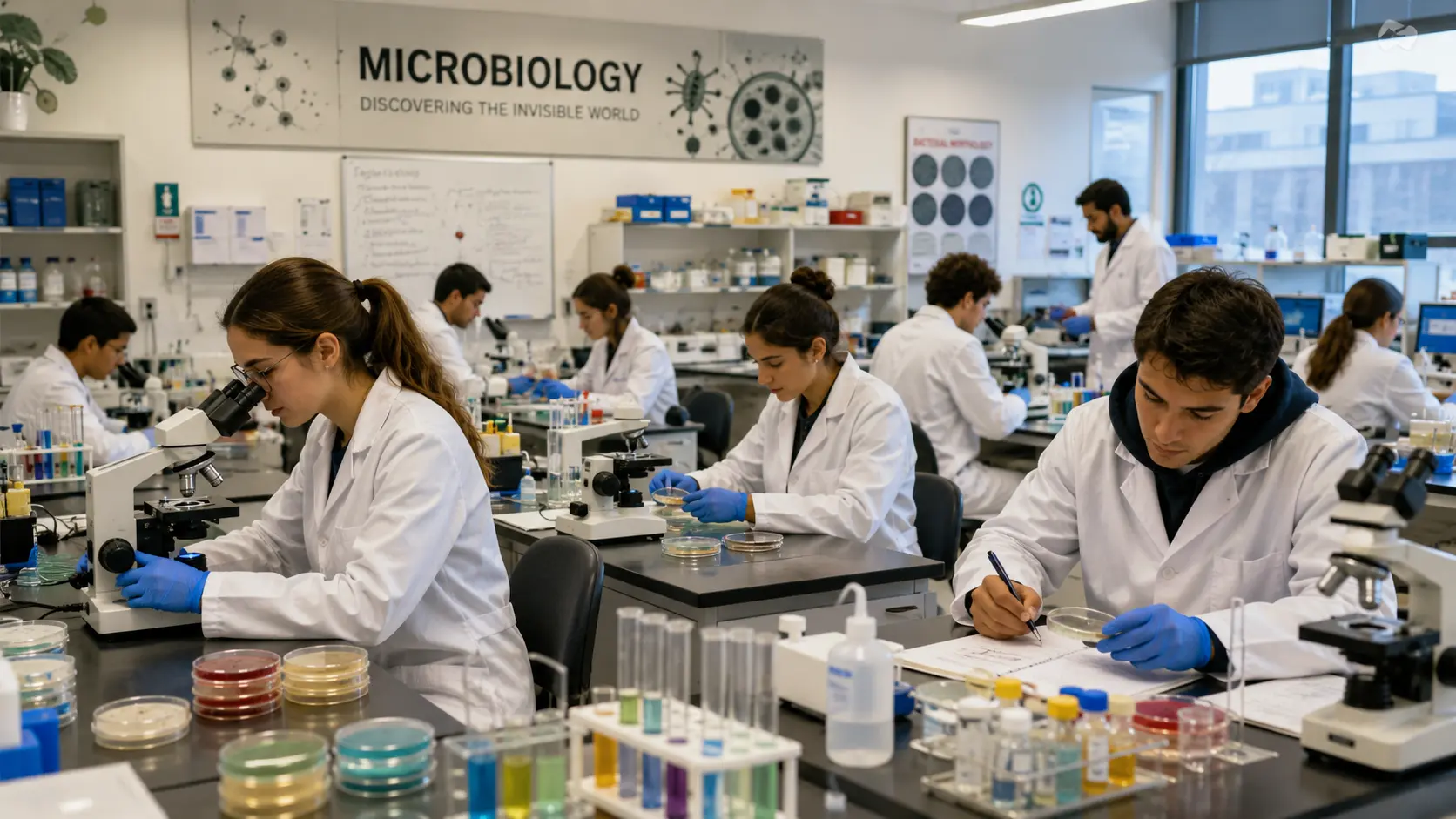
Laboratory work is a major part of the field.
For example, students may learn how to grow microorganisms under controlled conditions, examine samples under microscopes, isolate genetic material, interpret experimental results, and follow laboratory safety procedures.
What is the difference between microbiology and medical microbiology?
General microbiology is broad.
It can include microorganisms related to health, agriculture, food, industry, biotechnology, and the environment.
Medical microbiology focuses more closely on microorganisms associated with human disease.
Students in medical microbiology may study:
- Pathogenic bacteria
- Disease-causing viruses
- Fungal infections
- Parasites
- Immune responses
- Infection mechanisms
- Diagnostic laboratory methods
For example, Yeditepe University’s Medical Microbiology master’s curriculum includes General Microbiology, Sterilization, Disinfection and Antisepsis, Direct Diagnostic Methods in Microbiology, Medical Bacteriology, research methods, and thesis work.
Microbiology vs. Molecular Biology and Genetics
These subjects overlap, but they are not identical.
Microbiology focuses mainly on microorganisms.
Molecular Biology and Genetics examines biological processes at molecular and genetic levels across a much broader range of organisms.
This includes:
- DNA
- RNA
- Gene expression
- Genetics
- Cell biology
- Molecular mechanisms
- Biotechnology
For students searching for a bachelor’s degree, Molecular Biology and Genetics may be especially relevant because Turkish universities offer undergraduate programs in this field.
For example, Bilkent University describes its undergraduate Molecular Biology and Genetics program as covering biology and genetics alongside chemistry, physics, mathematics, molecular cell biology, bioinformatics, and hands-on laboratory training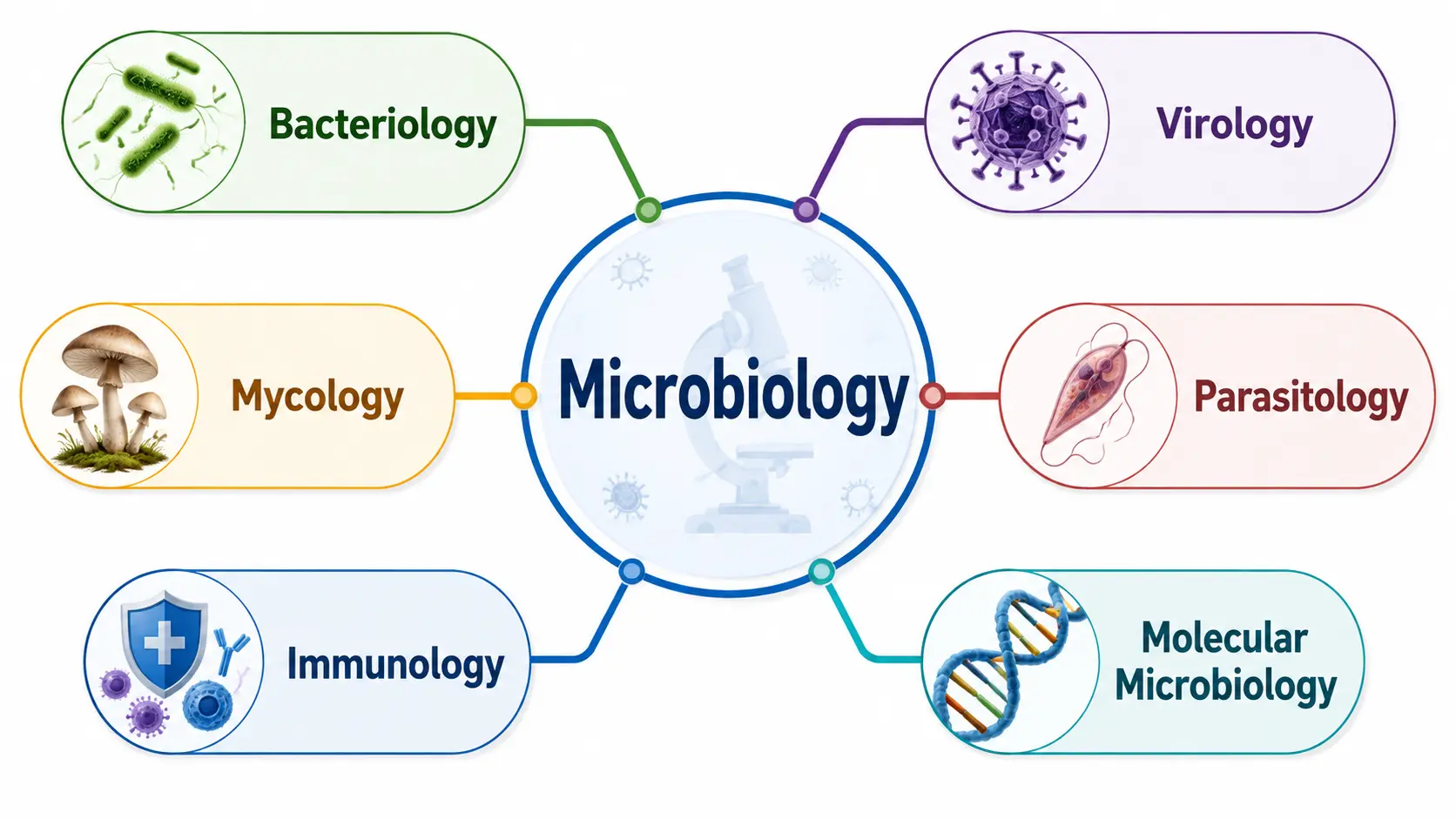 .
.
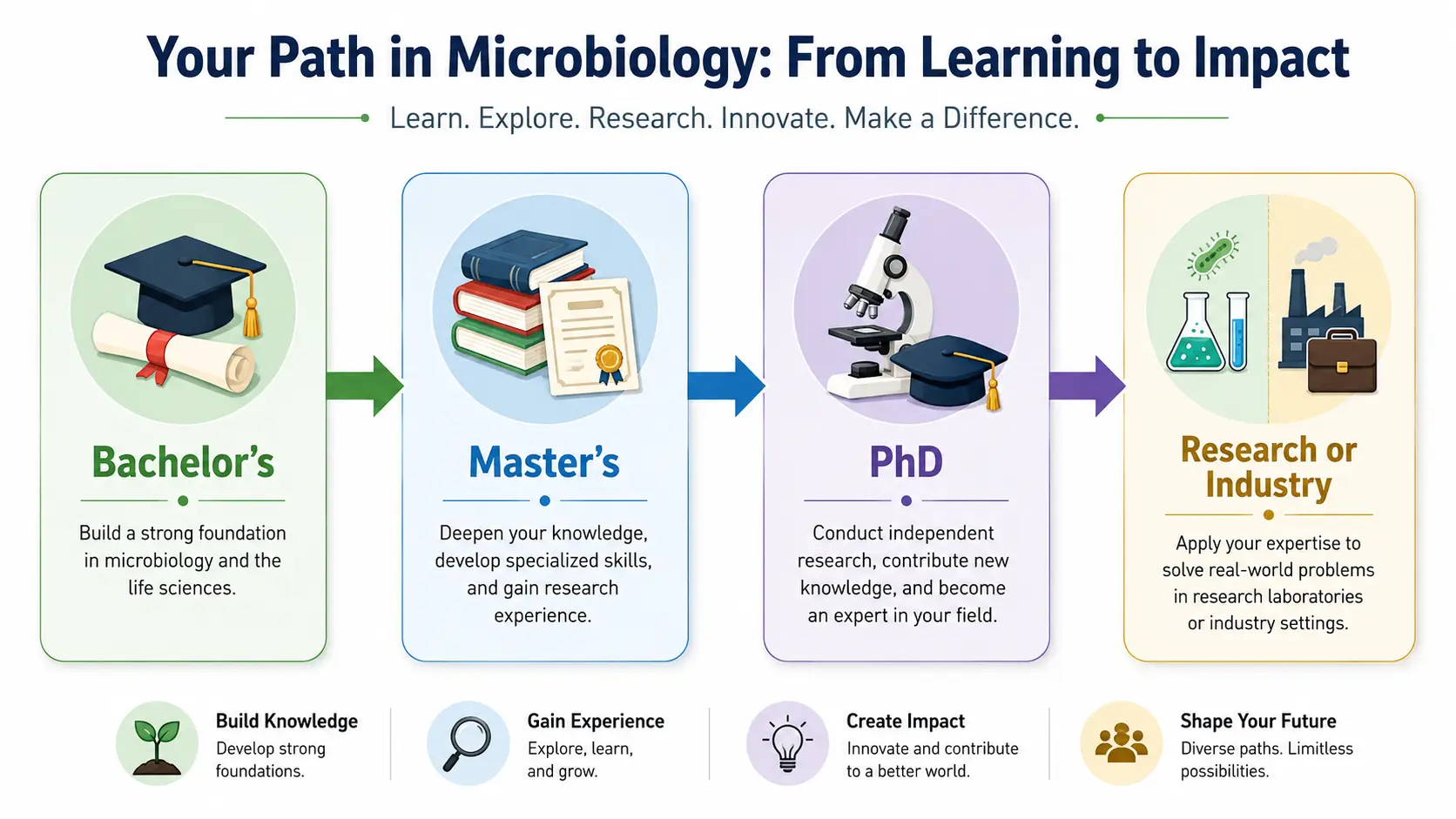
Can You Study Microbiology at Bachelor’s, Master’s, and PhD Levels in Turkey?
Yes, but the program name and availability can change significantly between degree levels.
Students should not assume that every university offers a degree literally called “Microbiology.”
Bachelor’s-level options
At undergraduate level, students interested in microbiology should search beyond the exact program title.
Relevant bachelor’s options may include:
- Molecular Biology and Genetics
- Biology
- Biotechnology
- Bioengineering
- Genetics and Bioengineering
- Related life-science programs
These programs can provide a foundation for later specialization in microbiology
Middle East Technical University, for example, has an undergraduate Molecular Biology and Genetics program. Its curriculum and learning outcomes include experimental techniques, molecular biology, molecular genetics, scientific research, and laboratory work
A student could therefore complete a related bachelor’s degree and later apply for a specialized microbiology master’s program, provided the graduate program accepts that academic background
Master’s programs in microbiology
Microbiology becomes more specialized at graduate level.
Hacettepe University currently lists both a Microbiology MSc and a Microbiology PhD among its graduate programs. Its microbiology master’s information states that the program is taught through the Faculty of Medicine’s Medical Microbiology Department and that foreign students may apply
Graduate programs may be:
- Thesis-based
- Non-thesis
- Research-focused
- Professionally focused
A thesis-based program usually requires students to complete original research under academic supervision
Medical Microbiology master’s programs
Medical Microbiology is particularly relevant for students interested in infectious diseases, laboratory diagnostics, microbial pathogenesis, or academic research
Yeditepe University currently offers a thesis-based Medical Microbiology master’s program taught in English. The university states that applicants may come from several relevant backgrounds, including Biology, Molecular Biology, Medicine, Pharmacy, Veterinary Medicine, Dentistry, and Medical Biological Sciences.
Istanbul Aydın University also lists Medical Microbiology master’s options. Its current program information shows a Turkish-taught thesis route and a Turkish-taught non-thesis route, with international students accepted.
PhD programs in microbiology
A PhD is designed primarily for advanced research.
Students typically move from structured coursework toward:
- Independent research
- Experimental design
- Scientific publication
- Thesis research
- Academic specialization
Hacettepe University lists a Microbiology PhD, while Istanbul Aydın University publishes information for a doctoral Medical Microbiology program
Students considering a PhD should pay close attention to faculty research areas rather than selecting a university only by reputation.
Your supervisor and laboratory may affect your research experience as much as the degree title.
Which Universities Offer Microbiology or Related Programs in Turkey?
There is no single list that should be treated as permanent.
Programs change, graduate schools update their admissions, and teaching languages can differ between departments
Students should use official university program pages for the intake they plan to enter
The following examples illustrate the different routes currently available
| University | Relevant Program | Level | Current Teaching Language | Main Route |
|---|---|---|---|---|
| Hacettepe University | Microbiology | MSc | Turkish | Thesis/research-focused graduate study |
| Hacettepe University | Microbiology | PhD | Check current program page | Advanced research |
| Yeditepe University | Medical Microbiology | MSc | English | Thesis |
| Istanbul Aydın University | Medical Microbiology | MSc | Turkish | Thesis |
| Istanbul Aydın University | Medical Microbiology | MSc | Turkish | Non-thesis |
| METU | Molecular Biology and Genetics | Bachelor’s | English | Related undergraduate route |
| Bilkent University | Molecular Biology and Genetics | Bachelor’s | Check current admissions page | Related undergraduate route |
Hacettepe’s official program information confirms that its microbiology master’s education takes place in the Faculty of Medicine’s Medical Microbiology classrooms and laboratories.
Yeditepe lists Medical Microbiology as an English-language thesis master’s program.
Istanbul Aydın currently describes its thesis Medical Microbiology master’s as Turkish-medium and open to foreign students.
How should you compare universities?
Do not compare institutions using rankings alone.
Start with the actual curriculum.
Look for:
- Microbiology courses
- Laboratory modules
- Research methodology
- Thesis opportunities
- Genetics and molecular biology
- Immunology
- Bacteriology
- Virology
- Bioinformatics
- Research projects
Then review faculty profiles
If you are interested in antibiotic resistance, for example, a university with an active laboratory researching bacterial resistance may be more suitable than a university whose strongest microbiology research is in another area
Finally, verify:
- Teaching language
- International admission rules
- Degree recognition
- Tuition
- Scholarship availability
- Laboratory access
- Research supervision
What Are the Admission Requirements for Microbiology Programs in Turkey?
Admission requirements depend on the university, degree level, nationality, and academic background
There is no universal application checklist that applies to every Turkish institution
Requirements for bachelor’s applicants
International bachelor’s applicants will normally need academic documents showing completion of secondary education
Depending on the university, students may be asked for:
- High school diploma
- High school transcript
- Passport
- Photograph
- Proof of language proficiency
- Accepted international or national examination results
- Translated documents
- Document verification or equivalency
The exact requirements must be checked on the university’s current international admissions page
Do not prepare for a particular examination only because another university requires it
Requirements for master’s applicants
Graduate applicants normally need a relevant undergraduate degree
Possible documents include:
- Bachelor’s diploma
- Academic transcript
- Passport
- CV
- Statement of purpose
- Language certificate
- Reference letters
- Research proposal
- Examination scores
- Interview
Not every university requests every item.
Academic background is particularly important.
For example, Yeditepe explicitly lists several degree backgrounds that may apply to its Medical Microbiology master’s, including Biology and Molecular Biology as well as several health-science disciplines.
Requirements for PhD applicants
PhD admission is usually more research-focused.
A university may examine:
- Your previous degree
- Grades
- Research experience
- Academic references
- Language proficiency
- Proposed research area
- Compatibility with faculty expertise
- Interview performance
Requirements for ALES, GRE, GMAT, or other examinations vary.
Check the specific graduate school rather than assuming that one test is compulsory everywhere.
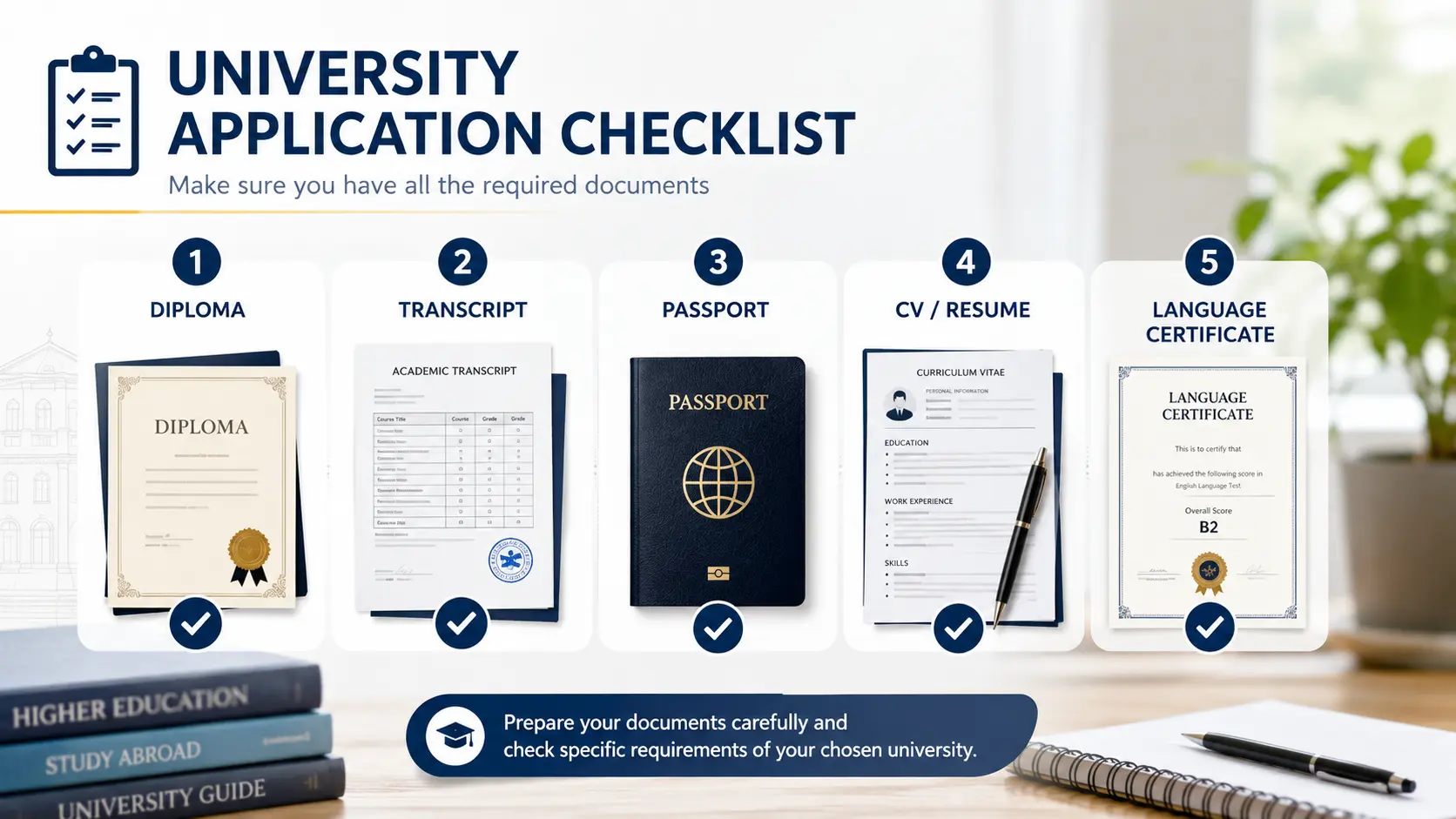
Documents international students should prepare
A useful preliminary file includes:
- Passport scan
- Diploma
- Transcript
- Official translations where required
- Language certificates
- CV
- Motivation letter
- Academic references
- Passport-style photograph
- Research proposal for programs that request one
Do not submit unofficial or edited academic documents
Can International Students Study Microbiology in Turkey in English?
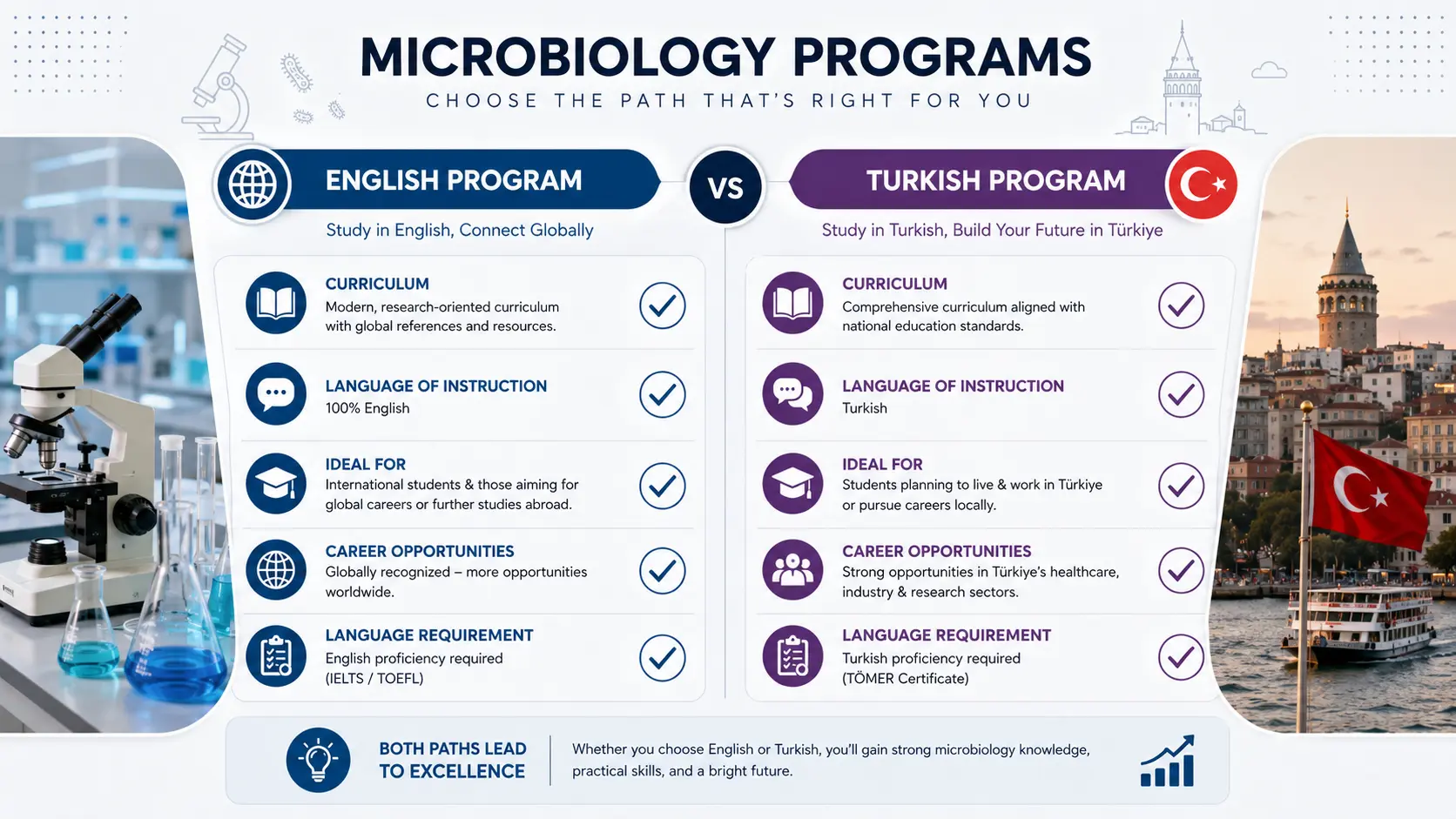
Yes, English-language options exist, but students should check the exact program
Language availability can differ even between universities offering similar subjects
Yeditepe University currently lists its thesis-based Medical Microbiology master’s as an English-language program
Hacettepe University’s current Microbiology master’s information states that the language of education is Turkish
Istanbul Aydın University also currently lists its Medical Microbiology master’s programs as Turkish-medium
This difference shows why students should never assume that a science program is taught in English
How should you verify the teaching language?
Check four places:
- The official program page.
- The university’s ECTS or Bologna information system.
- The graduate school or faculty page.
- The international admissions office.
If two pages disagree, contact the university before applying.
Real-world scenario: choosing an English bachelor’s route
Imagine that Sara wants to study microbiology entirely in English
She searches Turkish universities but cannot find a suitable standalone bachelor’s program titled “Microbiology.”
Instead of stopping there, she finds an English-language Molecular Biology and Genetics program
She opens the curriculum and checks whether it contains:
- Microbiology
- Genetics
- Molecular biology
- Laboratory training
- Cell biology
- Biotechnology
She then compares that curriculum with her long-term goal
If she wants to complete a master’s in microbial genetics later, the related bachelor’s route may provide a suitable foundation
The degree title alone does not answer the question
The curriculum does
How Much Does It Cost to Study Microbiology in Turkey?
There is no reliable single tuition figure for all microbiology students
Costs depend on:
- University
- Public or foundation status
- Degree level
- Program
- Scholarship
- Academic year
- City
Because fees change, students should use the current tuition page of the university they plan to attend.
Tuition fees
Public universities and private foundation universities use different fee structures.
Do not rely on old articles that quote one tuition amount for “studying in Turkey.”
Instead, record the current annual tuition for each shortlisted program:
University A: [replace with current official tuition]
University B: [replace with current official tuition]
University C: [replace with current official tuition]
This makes comparison easier and prevents outdated fee information from influencing your decision.
Laboratory and academic expenses
Science students may have costs that do not apply equally to every subject.
Depending on the university, these can include:
- Laboratory coat
- Protective equipment
- Books
- Printing
- Software
- Laboratory materials
- Transportation to practical placements
Ask whether these expenses are included in tuition.
Living expenses
Your major living costs are likely to include:
- Accommodation
- Food
- Local transport
- Health insurance
- Phone and internet
- Personal expenses
Istanbul may create a very different budget from a smaller university city.
Build your budget around the city where the campus is located rather than using a national average.
A practical budgeting method
Create three categories.
Fixed academic costs
- Tuition:
[replace with university data] - Registration costs:
[replace if applicable]
Monthly essential costs
- Accommodation:
[replace with current local data] - Food:
[replace with current local data] - Transportation:
[replace with current local data]
Flexible costs
- Books
- Entertainment
- Travel
- Personal purchases
Add an emergency reserve before deciding whether the program is affordable

Are Scholarships Available for Microbiology Students in Turkey?
Scholarship opportunities exist, but eligibility must be checked for the specific degree and application cycle
One major option for international students is Türkiye Scholarships
Türkiye Scholarships is a government-funded program covering multiple levels of higher education, including bachelor’s, master’s, and doctoral study
The scholarship program states that support can include university placement, tuition, accommodation, health insurance, Turkish-language education, a stipend, and other support depending on the scholarship route.
Eligibility rules and application periods can change, so students should check the current cycle rather than relying on previous dates
For example, the official announcement for the 2026 cycle listed applications from January 10 to February 20, 2026. Future applicants should verify the relevant year separately
University scholarships
Universities may also provide their own:
- Merit scholarships
- Tuition discounts
- Graduate scholarships
- Research funding
- Assistantships
The word “scholarship” can mean different things.
A tuition discount is not necessarily the same as a fully funded scholarship.
What should you check before accepting funding?
Ask:
- Does it cover full tuition?
- Does it cover accommodation?
- Is there a monthly stipend?
- How long does the funding continue?
- Is renewal automatic?
- Is there a minimum GPA?
- Does changing departments cancel the award?
- Does it cover the thesis period?
Read the written scholarship conditions rather than relying on promotional summaries

What Will You Study in a Microbiology Program?
The exact curriculum depends on specialization, but several subjects appear repeatedly
General microbiology
General microbiology introduces the structure, growth, metabolism, classification, and behavior of microorganisms
Students learn the vocabulary needed for more specialized courses
Bacteriology
Bacteriology focuses on bacteria
Students may learn how bacteria are classified, how they reproduce, how they cause disease, and how they respond to environmental conditions
Virology
Virology examines viruses, viral replication, host-virus interactions, and viral diseases
Mycology
Mycology is the study of fungi
Medical programs may focus more heavily on fungi that cause human infections
Parasitology
Parasitology examines organisms that live on or inside another organism and obtain resources from the host
Immunology
Immunology explains how the immune system recognizes and responds to infectious agents
This is particularly relevant to medical microbiology.
Molecular biology and genetics
Modern microbiology relies heavily on molecular techniques
Students may work with:
- DNA
- RNA
- Gene expression
- Genetic variation
- Molecular identification methods
METU’s Molecular Biology and Genetics curriculum, for example, includes molecular genetics and laboratory courses involving DNA, RNA, plasmid isolation, recombinant DNA techniques, and PCR.
PCR, or polymerase chain reaction, is a laboratory method used to produce many copies of a specific DNA region so that it can be studied more easily
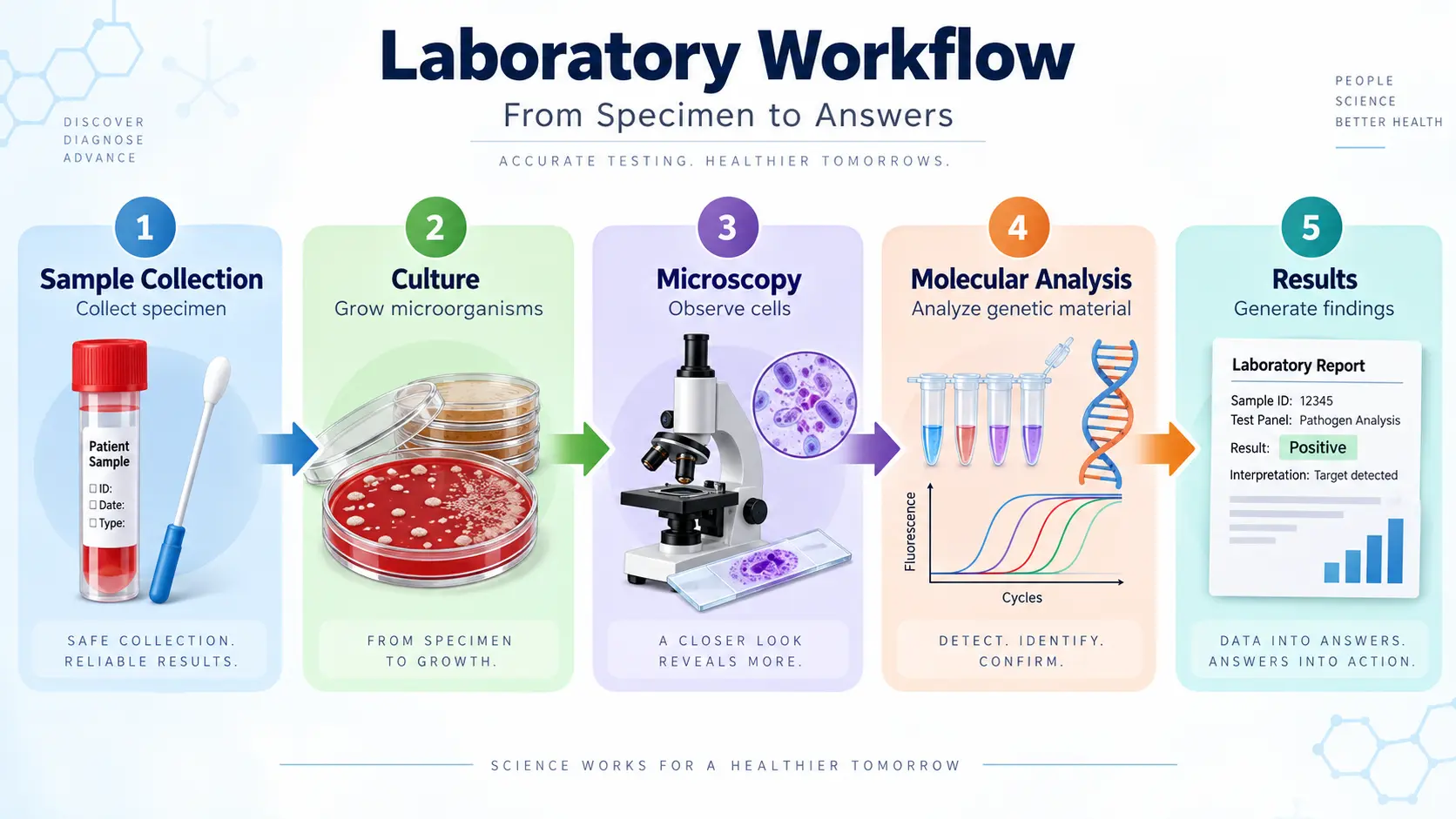
Laboratory methods
Laboratory training may include:
- Microscopy
- Sample preparation
- Sterilization
- Microbial culture
- Identification methods
- Molecular testing
- Experimental design
- Laboratory documentation
- Biosafety
Biosafety means following procedures designed to protect laboratory workers, the public, and the environment from biological hazards
Research methods and thesis work
Graduate programs place greater emphasis on research
Students learn how to:
- Identify a research problem
- Review scientific literature
- Form a research question
- Design an experiment
- Collect data
- Analyze results
- Write scientifically
- Present findings
A thesis then brings those skills together in one research project.
What Is Student Life Like for Microbiology Students in Turkey?
Microbiology is not only a classroom subject.
Students often spend significant time in laboratories.
Laboratory workload
A typical week may include:
- Lectures
- Laboratory practicals
- Reading
- Reports
- Group projects
- Presentations
- Examination preparation
Graduate students may spend additional hours conducting experiments.
Laboratory experiments do not always fit neatly into a lecture timetable.
Some procedures require preparation, incubation, repeated measurements, or later analysis.
What facilities should you look for?
Before choosing a university, investigate whether students have access to suitable laboratories.
Useful questions include:
- Are undergraduate students allowed to conduct practical experiments?
- Which instruments are available?
- Are there research laboratories?
- Can students join faculty projects?
- Are there biosafety facilities?
- Is there access to scientific databases?
- Are research internships available?
Choosing a city
The city matters because it affects your daily budget and lifestyle.
When comparing Istanbul, Ankara, Izmir, or another city, consider:
- Distance from accommodation to campus
- Public transport
- Housing availability
- Laboratory or industry opportunities
- Cost of daily life
For a laboratory-based degree, a long commute can become more significant than it first appears.
International student support
Check whether the university provides help with:
- Registration
- Orientation
- Residence procedures
- Student ID
- Language study
- Academic advising
- International exchange
This support can make the first semester easier.
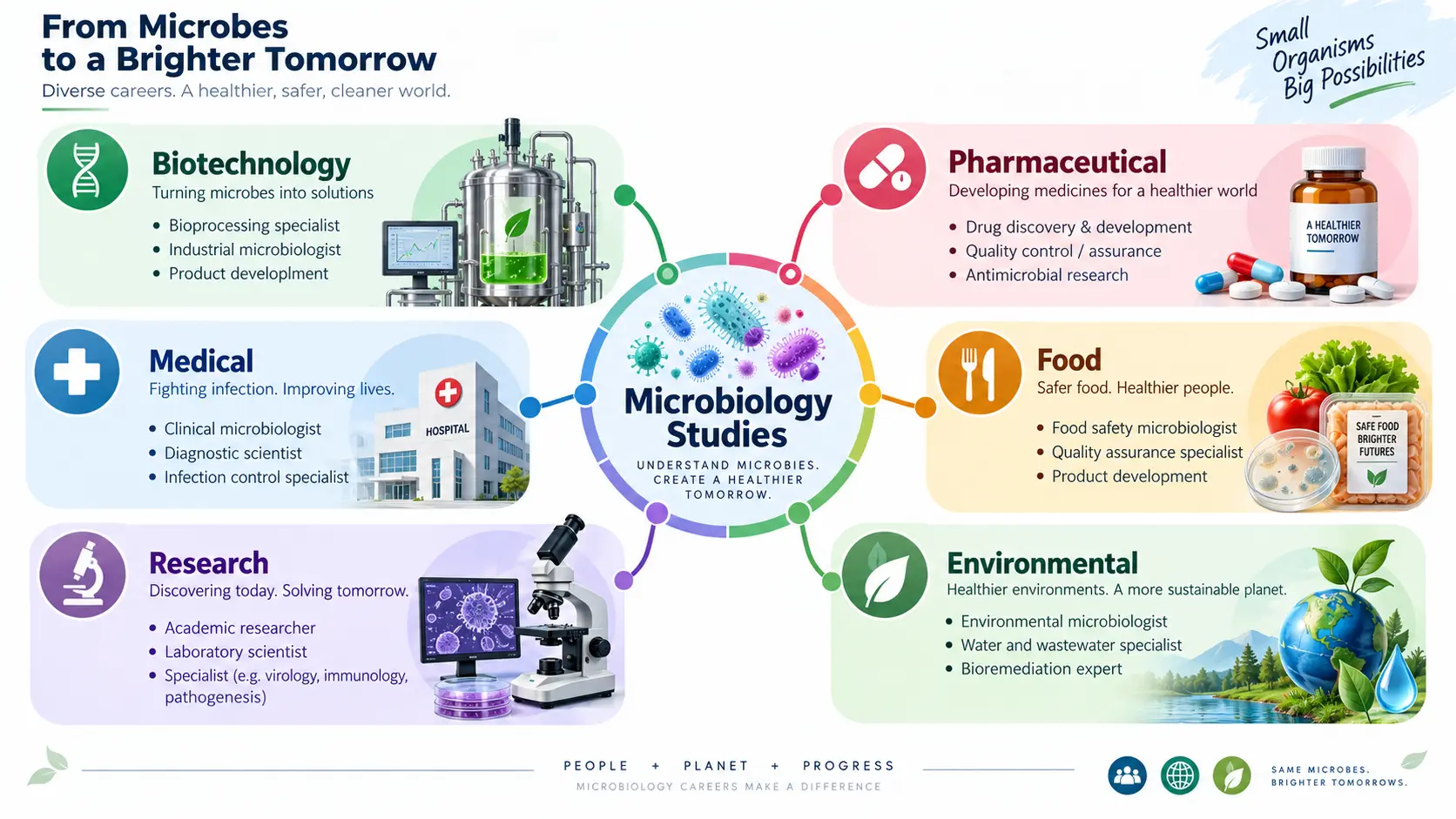
What Careers Can You Pursue After a Microbiology Degree in Turkey?
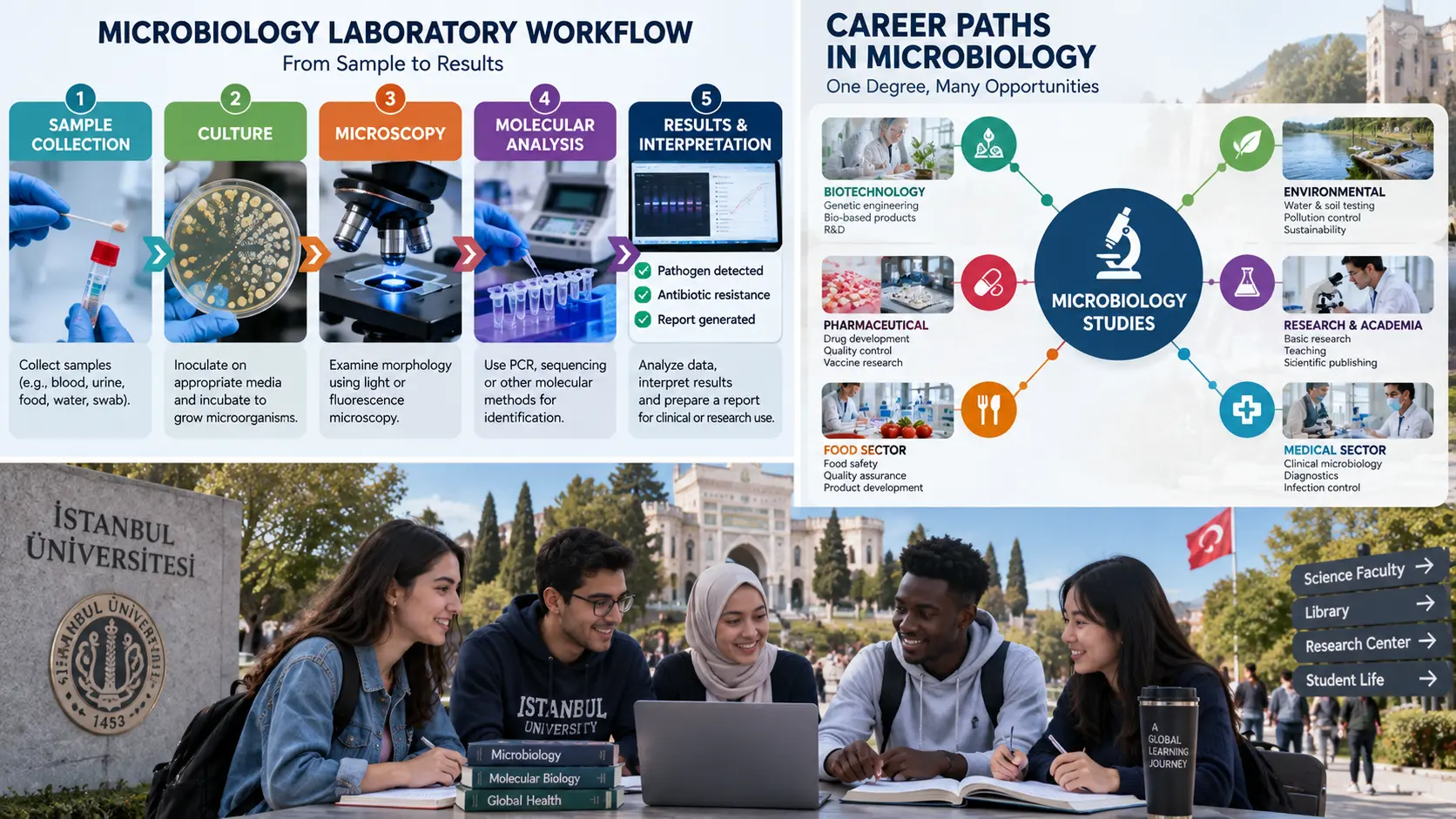
Microbiology can lead to several career directions.
The correct path depends on your degree, laboratory experience, specialization, and local professional regulations.
Research laboratories
Graduates may work in:
- University laboratories
- Research institutes
- Biotechnology laboratories
- Private research organizations
Roles may involve experimental work, data analysis, sample processing, or research assistance.
Biotechnology
Microorganisms are used in many biotechnology processes.
Possible fields include:
- Molecular diagnostics
- Genetic technologies
- Industrial biotechnology
- Biological product development
- Research and development
Pharmaceutical industry
Microbiology graduates may contribute to:
- Quality control
- Research
- Manufacturing processes
- Contamination monitoring
- Laboratory testing
Specific positions may require additional qualifications.
Food microbiology
Food companies need microbiological testing to help assess safety and quality.
Work may involve:
- Microbial testing
- Hygiene monitoring
- Quality assurance
- Food safety procedures
Environmental microbiology
Microorganisms are important in:
- Water
- Soil
- Waste treatment
- Environmental monitoring
- Bioremediation
Bioremediation means using living organisms, often microorganisms, to help remove or break down pollutants.
Medical and diagnostic laboratories
This area requires particular caution.
A degree related to microbiology does not automatically give graduates permission to perform every regulated clinical laboratory role.
Professional rules differ between countries.
Real-world scenario: planning a hospital career
Ali wants to complete an MSc in Medical Microbiology and then work in a hospital laboratory in his home country.
He finds a Turkish university program with excellent laboratory training.
Before enrolling, however, he contacts the professional authority responsible for laboratory licensing in his country.
The authority tells him which degrees are recognized for the role he wants.
Ali can now judge the program based on his actual career goal rather than assuming that the words “Medical Microbiology” automatically qualify him for clinical practice.
This check should happen before tuition is paid.
Academic careers
Students interested in university teaching or independent research normally continue to a PhD.
Academic careers often require:
- Research experience
- Publications
- Conference presentations
- Teaching experience
- A doctoral degree
Is a Microbiology Degree From Turkey Recognized Internationally?
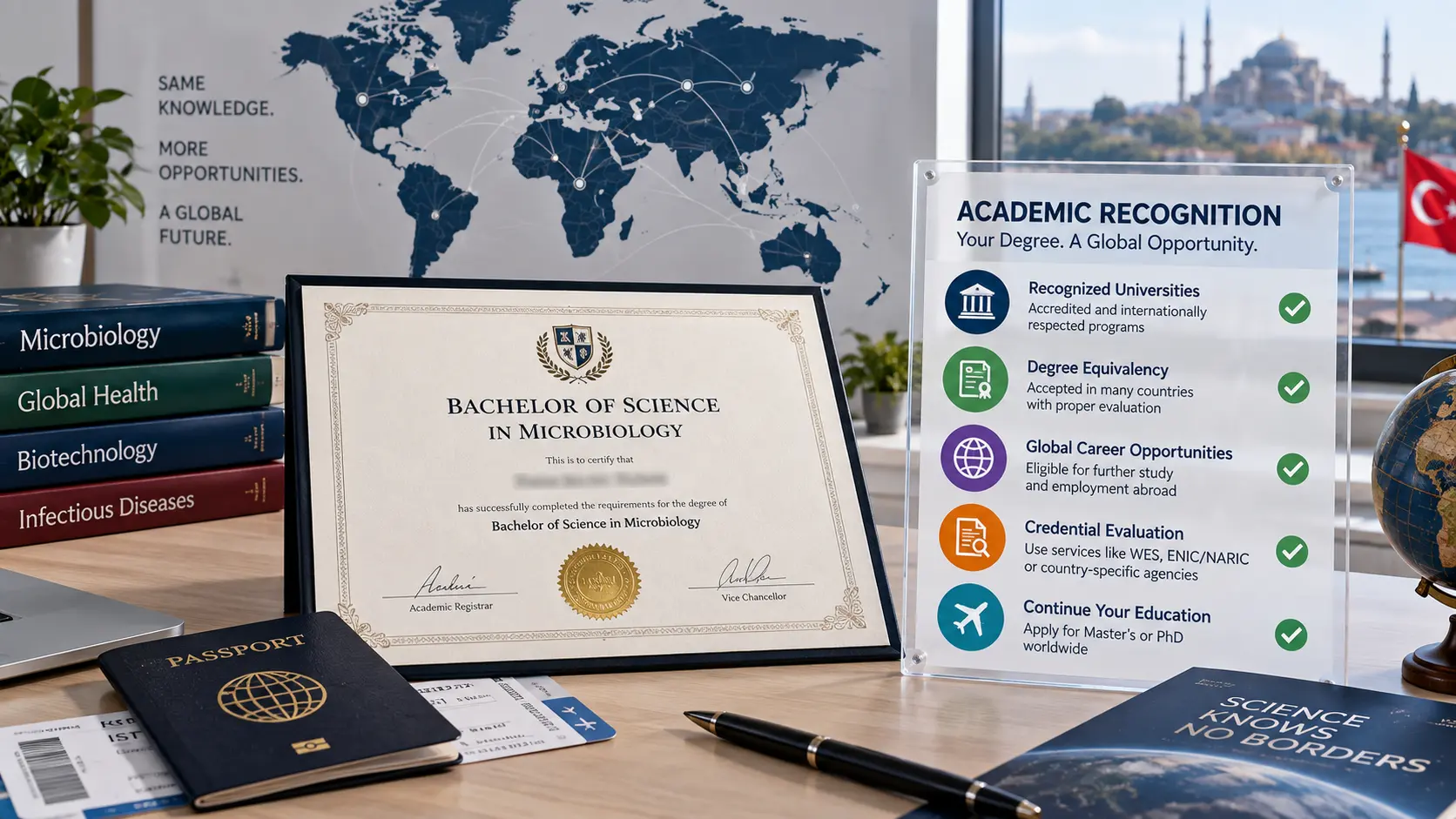
There is no single worldwide recognition rule.
Recognition depends on:
- University
- Degree
- Destination country
- Purpose of recognition
- Profession
Academic recognition and professional recognition are also different.
Academic recognition
If you want to complete another degree abroad, the receiving university decides whether your previous qualification meets its admission requirements.
It may examine:
- University status
- Degree level
- Credits
- Curriculum
- Thesis
- Transcript
Professional recognition
Regulated professions can require additional approval.
A regulated profession is a job for which the law requires specific qualifications, registration, licensing, or professional authorization.
Healthcare is a common example.
What should international students do?
Before enrolling:
- Identify the country where you want to work.
- Identify the profession you want to enter.
- Find the authority responsible for recognizing foreign qualifications.
- Ask whether the specific university and degree are acceptable.
- Keep the written response.
This is safer than relying on an education agency saying that a university is “internationally recognized.”
How Do You Apply to Study Microbiology in Turkey?
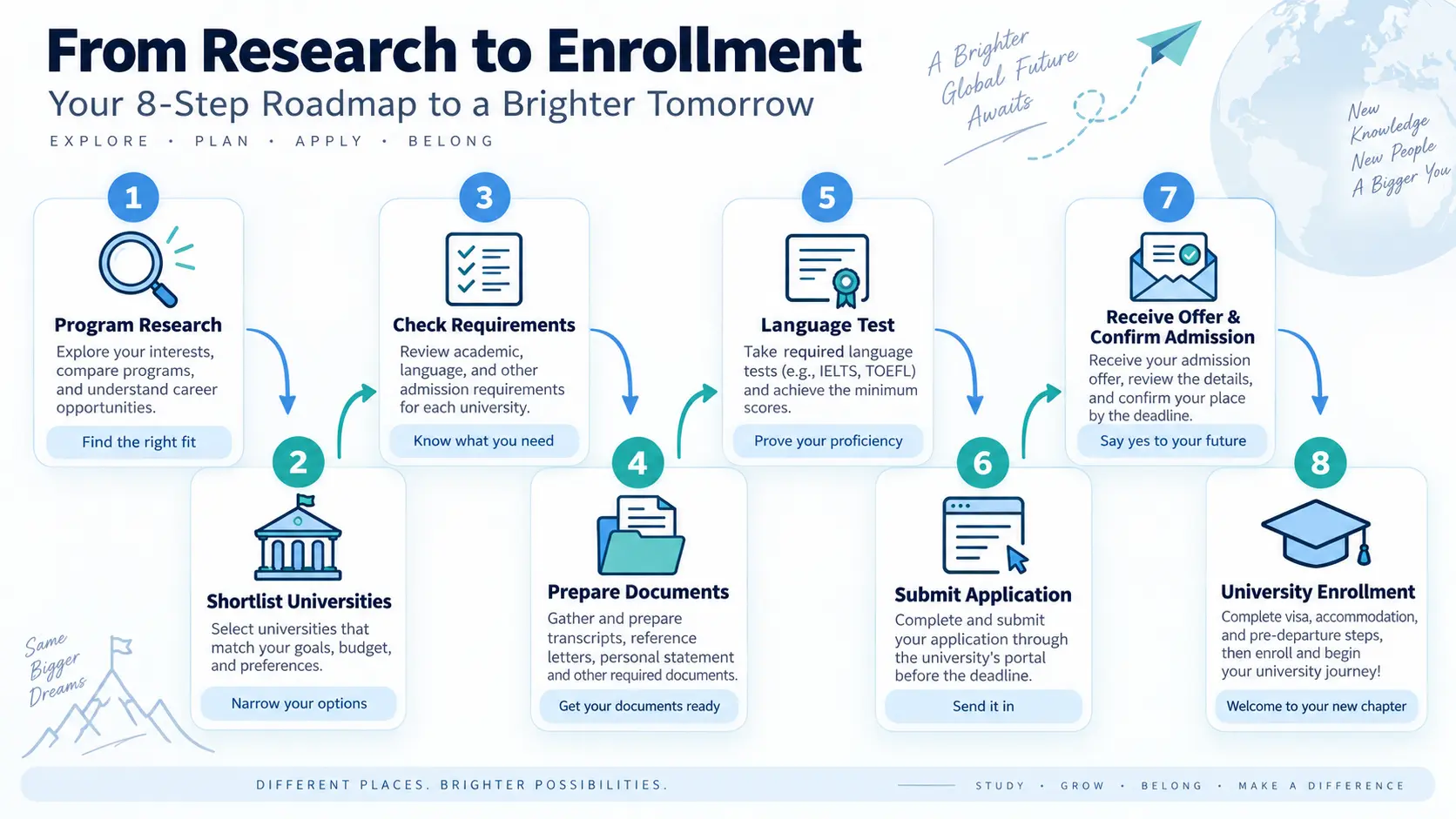
A good application process starts before filling in a form.
Step 1: Define your field
Decide what you actually want to study.
Possible routes include:
- General microbiology
- Medical microbiology
- Molecular microbiology
- Molecular biology and genetics
- Biotechnology
Step 2: Choose the degree level
Determine whether you need:
- Bachelor’s
- Master’s
- PhD
Your current qualification determines which route is possible.
Step 3: Build a university shortlist
Choose several universities rather than relying on one option.
Record:
- Program name
- Language
- Curriculum
- Tuition
- Admission requirements
- City
- Scholarship options
Step 4: Read the curriculum
This is one of the most important steps.
If your goal is microbial genetics, a program with strong genetics and molecular biology training may be more appropriate than another program with a broader title but little molecular work.
Step 5: Check eligibility
Compare your qualifications with the official admission requirements.
Do not assume that a Biology degree will be accepted by every Medical Microbiology program.
Step 6: Prepare documents
Prepare clean scans and official translations where required.
Keep a separate folder for each university because requirements may differ.
Step 7: Apply through official channels
Use the official university application system.
Check:
- Application deadline
- Required documents
- Application fee
- Interview
- Examination
- Language requirement
Step 8: Compare offers
An acceptance letter does not automatically mean the program is your best option.
Compare:
- Total cost
- Curriculum
- Laboratory opportunities
- Teaching language
- Faculty expertise
- Recognition
- Scholarship
- City
Step 9: Complete enrollment procedures
After accepting an offer, follow official instructions for enrollment, immigration, insurance, and residence procedures relevant to your nationality.
Rules can change, so use current government and university guidance.
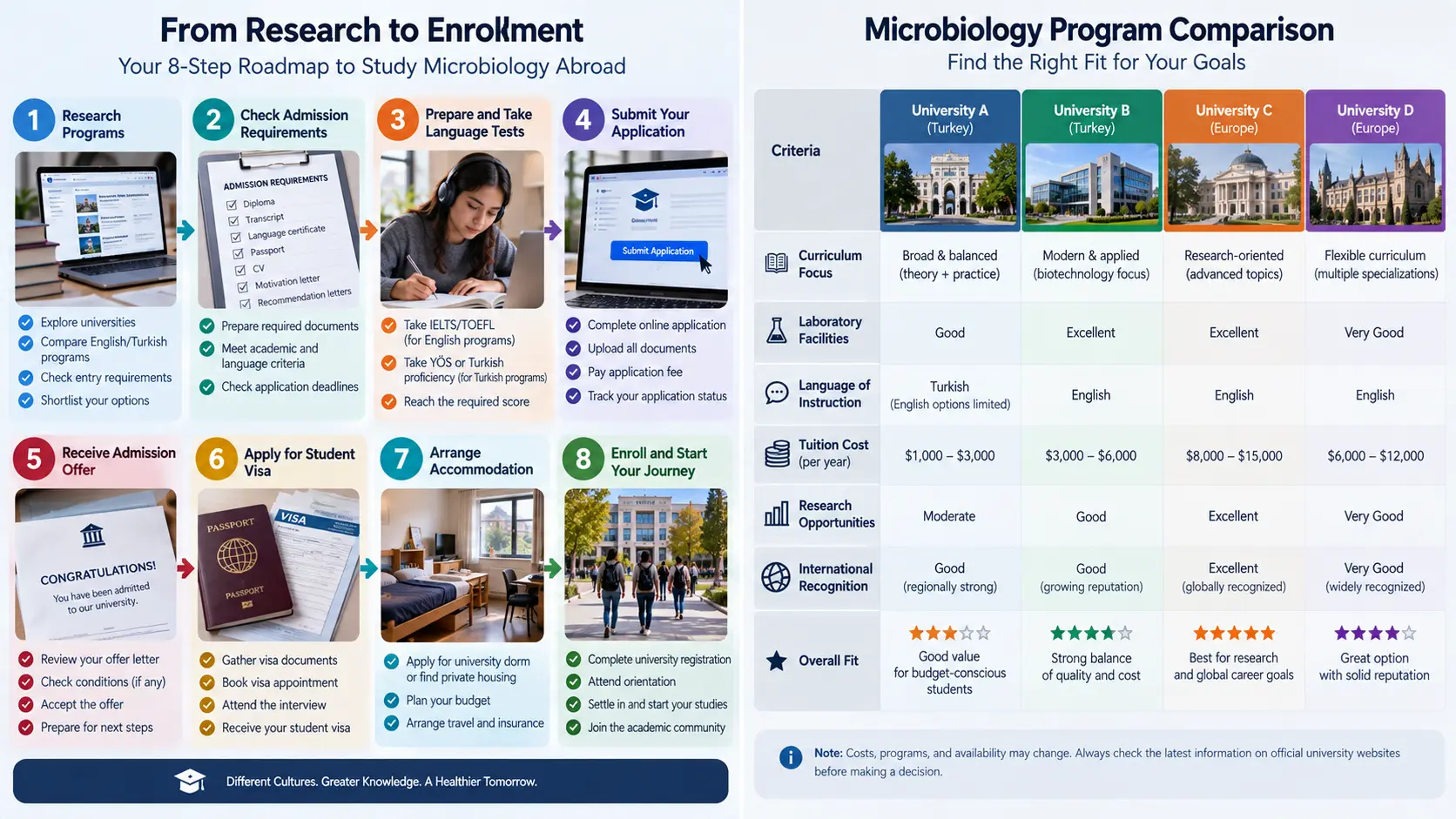
How Should You Choose the Best Microbiology Program in Turkey?
The “best” program is the one that fits your academic and professional objective.
Compare courses
Download the curriculum from each university.
Place them side by side.
Mark the courses most relevant to your goal.
Examine laboratory training
For microbiology, practical training is essential.
A curriculum full of theoretical subjects but limited laboratory access may not suit a student planning a laboratory career.
Review faculty research
This becomes especially important for graduate students.
Read faculty profiles and recent research areas.
Look for alignment with your interests.
Check the teaching language carefully
Do not choose an English program only because you prefer English.
Also consider where you want to work.
Learning Turkish may be useful for daily life, internships, communication, and local employment even if your program is taught in English.
Compare thesis opportunities
If you plan to apply for a PhD, research experience can be valuable.
A thesis-based MSc may suit that path better than a purely coursework-based degree.
That does not mean non-thesis programs are inferior.
They simply serve different goals.
Verify recognition
Do this before paying tuition.
Especially if your career involves healthcare, laboratory licensing, government employment, or further study abroad.
Is Studying Microbiology in Turkey a Good Choice for International Students?
It can be a good academic route for the right student.
Turkey offers different pathways across microbiology and related life sciences, including research-oriented graduate options and undergraduate programs in fields such as Molecular Biology and Genetics.
It may suit you if:
- You enjoy laboratory work.
- You are comfortable with biology and chemistry.
- You want research experience.
- You are interested in microorganisms, genetics, disease, biotechnology, food, or environmental science.
- You find a program whose curriculum matches your goal.
- You verify recognition before enrolling.
Consider alternatives if:
- You specifically need a professional clinical qualification.
- Your preferred university offers very little laboratory training.
- The program language does not suit you.
- You cannot confirm recognition in your target country.
- Another degree fits your intended profession more directly.
Do not choose the field only because microbiology sounds interesting.
Study the actual coursework and career pathway first.

What Should You Do Before Applying?
Turn your research into a short decision process.
First, decide which area interests you: medical microbiology, microbial genetics, biotechnology, environmental microbiology, or another branch.
Then choose your degree level.
Search both exact microbiology programs and related programs.
For bachelor’s applicants, this may include Molecular Biology and Genetics or other life-science degrees.
For graduate applicants, compare Microbiology and Medical Microbiology programs directly.
Next:
- Shortlist universities.
- Download each curriculum.
- Check the teaching language.
- Compare laboratory facilities.
- Read faculty research profiles.
- Confirm admission requirements.
- Calculate current tuition and living costs.
- Investigate scholarships.
- Verify degree recognition.
- Prepare the required documents.
- Apply through official university channels.
- Compare offers before committing.
If a university cannot clearly answer a question about language, curriculum, fees, or eligibility, get written confirmation before paying.
Frequently Asked Questions About Microbiology in Turkey
Can I study microbiology in Turkey in English?
Yes, some microbiology-related programs are taught in English. Availability depends on the university and degree level. Yeditepe University, for example, currently lists its thesis-based Medical Microbiology master’s in English, while Hacettepe University’s current Microbiology master’s information lists Turkish as the teaching language. Always verify the exact program before applying
Which universities in Turkey offer microbiology?
Examples currently include Hacettepe University for graduate Microbiology and Yeditepe University and Istanbul Aydın University for Medical Microbiology graduate study. At bachelor’s level, students may also consider related programs such as Molecular Biology and Genetics at universities including METU and Bilkent. Program availability should be checked directly with each university
What are the requirements to study microbiology in Turkey?
Requirements vary by university and level. Bachelor’s applicants normally need secondary-school academic documents and university-specific international admission requirements. Master’s and PhD applicants usually need a relevant previous degree, transcripts, language documents, and possibly references, examinations, interviews, or research materials
Can I study microbiology in Turkey after a biology degree?
Potentially, yes. Some graduate microbiology programs accept Biology graduates. Yeditepe University currently lists Biology and Molecular Biology among the academic backgrounds eligible to apply for its Medical Microbiology master’s. Other universities may use different eligibility rules
How much does it cost to study microbiology in Turkey?
There is no single national tuition fee. Costs depend on the university, program, degree level, scholarship, and academic year. Students should check current tuition directly on each university’s official website and separately calculate accommodation, food, transport, insurance, and academic expenses
What jobs can I get after studying microbiology in Turkey?
Possible fields include scientific research, biotechnology, pharmaceuticals, food microbiology, environmental laboratories, quality control, and academic research. Some medical or diagnostic laboratory positions may be regulated and require additional professional recognition or licensing