


Tuition is only half of the money question. The other half is rent, food, transport and the dozens of small payments that add up over a semester. The good news is that the cost of living in China for students is still moderate by international standards, and in most cities a careful student can live comfortably on 3,000 to 4,500 RMB a month. Beijing and Shanghai are a different story, and that is where most budgeting mistakes happen
The figures below come from what our students actually report spending, checked against university guidance. Prices move every year, so treat them as realistic ranges rather than fixed numbers. At the time of writing, one US dollar buys roughly 7 RMB
Monthly budget by city
Where you study matters more than anything else. Chinese cities are often grouped into tiers, and the gap between a tier-one city and a provincial capital can easily be 2,000 RMB a month, mostly because of rent. Here is a rough monthly picture for a student living in a university dormitory and eating mainly on campus
| City type | Examples | Dorm student per month | Off-campus per month |
|---|---|---|---|
| Tier one | Beijing, Shanghai, Shenzhen | About 3,500 to 5,000 RMB | About 6,000 to 9,000 RMB |
| Large tier two | Hangzhou, Nanjing, Guangzhou | About 3,000 to 4,500 RMB | About 4,500 to 6,500 RMB |
| Provincial capitals | Wuhan, Chengdu, Xi’an, Changsha | About 2,500 to 3,800 RMB | About 3,500 to 5,000 RMB |
| Smaller cities | Harbin, Kunming, Nanning, Jinhua | About 2,000 to 3,200 RMB | About 3,000 to 4,000 RMB |
Those totals include rent, food, a phone plan, local transport and a modest amount for going out. They do not include tuition, flights or one-off costs at the start of the year, which we cover further down. If you have not picked a city yet, our list of the leading universities in China for foreign students shows which cities each one is in
Accommodation costs
Most international students spend their first year in the international dormitory, and we recommend it. You avoid deposits, agency fees and the paperwork of registering a private address with the police. Dormitory prices are often quoted per day or per year. A shared double room usually costs 4,000 to 10,000 RMB a year, while a single room with a private bathroom can be 10,000 to 25,000 RMB a year in Beijing or Shanghai
Off-campus apartments give you more space and freedom but cost more than students expect. A one-bedroom near a central university in Shanghai or Beijing typically runs 4,500 to 8,000 RMB a month. In Wuhan, Chengdu or Xi’an the same flat might be 1,800 to 3,500 RMB. Landlords usually ask for one or two months’ deposit plus the first one to three months in advance, and if you use an agency, expect a fee of up to one month’s rent
Registering your address
If you live off campus, you must register at the local police station within 24 hours of moving in. Your landlord should help. Students who skip this step run into problems when they renew their residence permit, and fines are possible
Food and groceries
Food is where China is cheapest. University canteens serve full meals for roughly 10 to 20 RMB, and many students eat almost every meal there. A simple meal at a local restaurant costs 25 to 50 RMB, and a dinner at a mid-range restaurant with friends is around 60 to 120 RMB per person. Western food, imported cheese and good coffee are where budgets slip, so a daily latte habit can easily cost 500 RMB a month
For groceries, local markets and chains like Yonghui or Hema are much cheaper than imported-goods stores. If you cook for yourself, a realistic food budget is 1,000 to 1,800 RMB a month. Food delivery through Meituan or Ele.me is cheap and very convenient, which is exactly why it is easy to overspend
Transport and getting around
Public transport is excellent and cheap. Metro rides in most cities cost 2 to 10 RMB depending on distance, buses are usually 1 to 2 RMB, and shared bikes cost around 1.5 RMB per ride. Students who live on campus often spend less than 150 RMB a month on transport. Didi, the ride-hailing app, is affordable for occasional trips
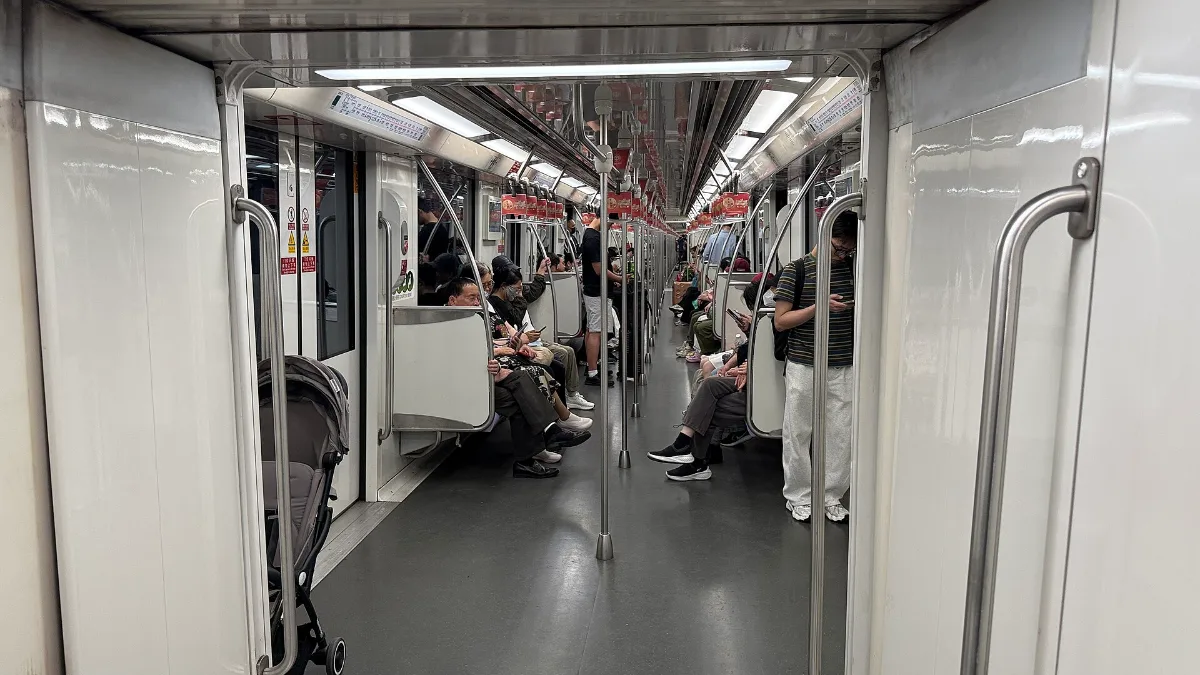
Travel between cities is also good value. A second-class high-speed train ticket from Beijing to Shanghai costs roughly 550 to 670 RMB, and student discounts exist on some routes, but many international students do not qualify because the discount card is linked to Chinese student IDs
Phone, internet and daily expenses
- Mobile phone plan with data: about 50 to 120 RMB a month from China Mobile, China Unicom or China Telecom
- Home internet if you live off campus: around 100 RMB a month
- Utilities for an apartment: 200 to 500 RMB a month, more in summer with air conditioning and in northern winters
- Toiletries and household items: 100 to 200 RMB a month
- Gym membership: 150 to 400 RMB a month, though many campuses have cheap or free sports facilities
- Entertainment and social life: anything from 300 to 1,500 RMB, depending on your habits
One-off costs in your first year
The first few weeks are the most expensive, and this is where students run short. Plan for these on top of your monthly budget
- Residence permit fee, typically around 400 to 800 RMB depending on validity
- Medical check on arrival if your home exam is not accepted, roughly 400 to 600 RMB
- Student health insurance, usually about 800 RMB per year
- Bedding, kitchen items and a SIM card, around 500 to 1,500 RMB
- Deposit and agency fee if you rent privately, often one to three months’ rent
- Winter clothes if you are studying in the north, easily 1,000 RMB or more
In our experience, arriving with at least 8,000 to 12,000 RMB available for the first month, separate from tuition, removes most of the stress
How scholarships change the picture
A full Chinese Government Scholarship covers tuition, on-campus accommodation and insurance, and pays a monthly stipend of 2,500 RMB for bachelor’s students, 3,000 RMB for master’s and 3,500 RMB for PhD students. Outside tier-one cities that stipend covers most of a student’s daily costs. In Shanghai or Beijing it is tight but manageable if you stay in the dormitory. Our guide to the Chinese Government Scholarship 2027 explains how to apply and what each type covers
Partial scholarships and tuition waivers are more common, and they still leave you paying living costs yourself. If you are comparing destinations, our guide to student living costs in Turkey is a useful reference point, since many families consider both countries
Want a realistic budget for your city and university?
Our advisers can estimate your full first-year cost, including tuition, accommodation and arrival expenses, and check which scholarships you could apply for. Book a free consultation
Ways students save money
The students who manage best usually do a few simple things. They stay in the dormitory for the first year, eat in the canteen, learn enough Chinese to shop in local markets and avoid buying everything through delivery apps. Learning the language pays off quickly here, and preparing for the HSK Chinese test gives you a structure for it
Choosing a city carefully is the biggest saving of all. A student at a strong university in Wuhan or Chengdu can spend 1,500 to 2,500 RMB less each month than a classmate in Shanghai, which over a four-year degree is more than many students pay in tuition
Your next step
Pick two or three target cities and build a simple spreadsheet with rent, food, transport and a buffer of about 15 percent. Then compare it with what your family can realistically send each month. If the numbers do not work in Beijing, they may work very well in Hangzhou or Xi’an. For the full application process, start with our guide on how to apply to study in China
Frequently Asked Questions
How much money does a student need per month in China?
Most students outside Beijing, Shanghai and Shenzhen spend around 3,000 to 4,500 RMB a month living in a dormitory. In tier-one cities, plan for about 3,500 to 5,000 RMB in a dormitory and 6,000 RMB or more if you rent privately
Is China cheaper than Europe for students?
Generally yes. Rent, food and transport in most Chinese cities cost considerably less than in Western Europe, although central Shanghai and Beijing can be close to some European cities for housing
Does the CSC stipend cover living costs?
In most cities it covers daily expenses for students living on campus. In Beijing and Shanghai it is tight, especially for bachelor’s students on 2,500 RMB a month
Can I work part-time to cover my costs?
Part-time work is allowed only with your university’s approval and an annotation on your residence permit. Opportunities are limited, so do not rely on a job to pay your living costs
What is the cheapest city in China for international students?
Smaller cities and provincial capitals such as Harbin, Kunming, Nanning, Changsha and Xi’an are among the most affordable, with total monthly costs often between 2,500 and 3,500 RMB





