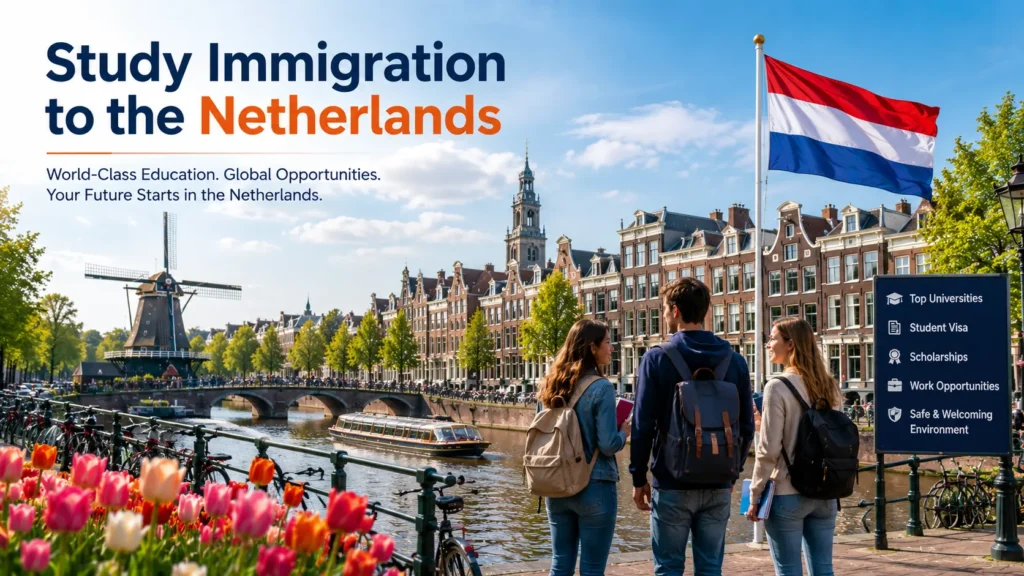

Navigating the complexities of international education often begins with understanding immigration procedures. For those aspiring to pursue higher education abroad, Study immigration to the Netherlandsoffers a world-renowned academic system coupled with a vibrant cultural experience. This guide aims to demystify the process, providing a clear roadmap for prospective students from outside the European Union
The Netherlands stands as a beacon of innovation and academic excellence, attracting thousands of international students each year. Its universities consistently rank among the best globally, offering a vast array of English-taught programs. Beyond the classroom, the country boasts a high quality of life, a welcoming international community, and a unique blend of historical charm and modern dynamism. However, the dream of pursuing your education in this picturesque European nation hinges on a thorough understanding of its immigration framework. This comprehensive guide, supported by the expertise of Saya Group, is designed to be your go-to resource, simplifying the intricate steps required to transform your academic aspirations into a tangible reality
The Key Distinction: Entry Visa (MVV) and Residence Permit (VVR) for Studying in the Netherlands
One of the initial hurdles for international students pursuing Study in the Netherlandsis distinguishing between an Entry Visa (MVV) and a Residence Permit (VVR). While these terms often cause confusion, understanding their specific functions is crucial for a smooth immigration process. Most students from non-EU/EEA countries will require both.
The MVV (Machtiging tot Voorlopig Verblijf), or Provisional Residence Permit, is essentially an entry visa. Its primary purpose is to allow you to legally enter the Netherlands. For many nationalities, this sticker in your passport serves as the initial permission to travel to the country. It is a temporary document, usually valid for a limited period, typically 90 days, during which you must complete the final steps to secure your long-term residency. This preliminary visa ensures that your arrival in the Netherlands is fully authorized by the Dutch authorities, setting the stage for your extended academic stay
In contrast, the VVR (Verblijfsvergunning Regulier), or Regular Residence Permit, is the official document that grants you legal permission to live and and study in the Netherlands for the duration of your academic program. This permit is usually issued as a physical card, similar to an ID card, and explicitly states your purpose of stay (e.g., “study”). The VVR allows you to reside in the Netherlands for more than 90 days, enabling you to immerse yourself fully in your studies and Dutch life. It is important to note that while the MVV facilitates your entry, the VVR is what authorizes your continuous, long-term presence in the country
For the majority of non-EU/EEA students, the application for both the MVV and VVR is typically handled through a streamlined process known as the “facilitated procedure.” Under this system, your chosen Dutch university acts as your sponsor and manages the application on your behalf. This significantly simplifies the process for students, as the university submits the necessary documentation to the Immigration and Naturalisation Service (IND). This integrated approach underscores the vital role of your educational institution in facilitating your journey to Study in the Netherlands, ensuring a coordinated and efficient route from application to arrival
Step-by-Step Study Immigration to the Netherlands
Embarking on your educational journey to the Netherlands requires careful planning and execution of several key steps. Saya Group has outlined a clear, sequential guide to help you navigate the process of Study immigration to the Netherlands, from securing admission to settling in
Step 1: Gaining Admission to a Dutch University – The Role of a Recognized Sponsor
The foundation of your journey to Study in the Netherlandsbegins with securing admission to a recognized Dutch educational institution. The Dutch Immigration and Naturalisation Service (IND) requires that all international students applying for a long-term residence permit (VVR) be admitted to a university or institution that holds the status of a “recognized sponsor.” This status is granted by the IND to educational institutions that meet specific criteria, ensuring they are reliable and capable of overseeing the immigration process for their international students. Choosing a university with this designation is not merely a recommendation; it is a mandatory prerequisite for your student visa application
The first practical step involves researching and selecting a program that aligns with your academic and career aspirations. The Netherlands offers a diverse range of Bachelor’s, Master’s, and PhD programs across various fields, many of which are taught entirely in English. You can explore universities through national databases like Study in Holland or directly on university websites. Pay close attention to program entry requirements, which typically include specific academic qualifications, grade point averages, and standardized test scores (e.g., GRE, GMAT for certain Master’s programs)
Once you have identified your desired program and university, the application process usually involves submitting an online application via Studielink, the national application portal for higher education in the Netherlands. Beyond the online form, you will need to prepare a comprehensive application package. This package typically includes your academic transcripts and diplomas from previous educational institutions, a compelling motivation letter explaining your interest in the program and your career goals, at least two letters of recommendation from professors or employers, and a detailed curriculum vitae (CV). Some programs may also require specific essays or portfolios. Meeting all application deadlines is critical, as Dutch universities often have strict cut-off dates, especially for international applicants, to allow sufficient time for immigration procedures. Saya Group can assist you in preparing a strong application to maximize your chances of admission
Upon receiving an offer of admission, your chosen university officially becomes your “recognized sponsor.” This is a pivotal moment, as the university will then take the lead in initiating your MVV and VVR application process with the IND. Their status as a recognized sponsor means they are responsible for certain aspects of your immigration, including verifying your financial solvency and academic progress. This streamlined system significantly simplifies the administrative burden on international students, making the path to Study in the Netherlandsmore accessible and manageable
Step 2: Preparing Your Financial Documents – Demonstrating Sufficient Funds
A crucial component of your application for Study immigration to the Netherlandsis demonstrating that you possess sufficient financial means to support yourself throughout your stay. The Dutch government wants assurance that you will not become a financial burden on the state. The Immigration and Naturalisation Service (IND) sets a minimum monthly amount for living expenses, which is updated annually. This amount is separate from your tuition fees. For example, for the academic year 2024-2025, students generally need to prove access to approximately €1,209.60 per month, or €14,515.20 per year, for living costs, in addition to their tuition fees
The purpose of this financial requirement is to cover your daily expenses, including accommodation, food, transportation, books, and personal needs. It’s important to understand that tuition fees are a separate cost and must also be accounted for. While the IND specifies a minimum, it is always advisable to have access to a slightly higher amount to comfortably manage unexpected expenses and enjoy your student life without constant financial stress
Acceptable proof of funds can take several forms. The most common method is a bank statement from your personal savings account, showing a balance that covers at least one year’s worth of living expenses and, often, the first year’s tuition fees. This statement must be recent, usually no older than three months, and must clearly show your name as the account holder. The funds must be readily accessible. Alternatively, if you are being sponsored by a parent or guardian, they can provide a sponsor declaration along with their bank statements, confirming their commitment to financially support you. Scholarships, grants, and student loans can also be used as proof of funds, provided there is official documentation confirming their value and duration.
In many cases, your Dutch university, acting as your recognized sponsor, will play a direct role in verifying your financial solvency. They often require you to transfer the required amount for living expenses (and sometimes the first year’s tuition) into a university bank account. The university then holds these funds in a blocked account and disperses them to you monthly or periodically after your arrival in the Netherlands. This method offers a secure and straightforward way to satisfy the IND’s financial requirements, providing both the student and the authorities with peace of mind regarding financial stability during your Study in the Netherlands
Step 3: The Visa and Residence Permit Application Process by the University
Once you have received your official admission letter and demonstrated sufficient financial means, the most significant administrative step for Study immigration to the Netherlandsbegins: the actual application for your MVV and VVR. For non-EU/EEA students, this process is predominantly facilitated by your chosen Dutch university, leveraging their status as a “recognized sponsor.” This means that unlike applying for a tourist visa, you generally do not apply for your student visa directly at a Dutch embassy or consulate in your home country. Instead, the university acts as an intermediary, submitting the necessary paperwork to the Immigration and Naturalisation Service (IND) on your behalf
The university will typically send you a detailed checklist of documents required for your immigration application. This list might include, but is not limited to: high-resolution scans of all pages of your valid passport, your birth certificate (often legalized or apostilled), official academic transcripts and diplomas, proof of English proficiency (e.g., IELTS, TOEFL scores), and a completed antecedent certificate (a declaration regarding your criminal record, if any). You may also need to sign a declaration of intent to obtain a TB test upon arrival, depending on your nationality. It is paramount to provide all requested documents accurately and promptly, as any missing or incorrect information can cause significant delays in your application processing
After you submit all required documents to your university and transfer the necessary funds (if they are handling your financial proof), the university compiles your application dossier. They then submit this comprehensive package to the IND. The IND will assess your application based on criteria such as your admission to a recognized institution, proof of sufficient funds, valid travel documents, and a clean criminal record. Once the IND approves your application, they will issue the MVV (if required for your nationality) and the approval for your VVR. You will then receive a notification from your university or directly from the IND, indicating that your MVV is ready for collection at the designated Dutch embassy or consulate in your country of residence
The processing time for these applications can vary. While many applications submitted through recognized sponsors are processed efficiently (often within two to four weeks), the IND’s official maximum processing time can be up to 90 days. It is always wise to account for potential delays, especially during peak application periods. Upon receiving confirmation that your MVV has been approved, you will need to schedule an appointment at the Dutch diplomatic representation to have the MVV sticker placed in your passport. This step officially completes the entry visa aspect of your Study immigration to the Netherlands, allowing you to book your flight and prepare for your exciting new chapter
Step 4: Biometrics and Receiving Your Residence Card Upon Arrival in the Netherlands
Your journey with Study immigration to the Netherlandscontinues even after you’ve landed in the country. The final steps involve official registration and obtaining your physical residence permit card, which is your proof of legal residency. These procedures are crucial for ensuring your full integration into Dutch society and for accessing essential services
Upon your arrival, one of your first mandatory tasks will be to register with the local municipality (gemeente) where you will be residing. This registration is known as the Basisregistratie Personen (BRP), or Municipal Personal Records Database. You will typically need to schedule an appointment for this, bringing your valid passport with your MVV (if applicable), your admission letter, and proof of your Dutch address (e.g., rental contract). During this appointment, you will receive your BSN (Burgerservicenummer), a unique citizen service number. The BSN is vital for virtually all administrative interactions in the Netherlands, including opening a bank account, setting up utilities, receiving a salary, and arranging health insurance. Without a BSN, many aspects of daily life can become incredibly challenging
Shortly after your arrival and often in conjunction with your municipal registration, you will need to attend a biometrics appointment at one of the IND’s desks. This appointment is essential for the production of your actual residence permit card. During the biometrics appointment, your fingerprints will be taken, and a digital photograph will be captured. This data is then used to create your personalized VVR card. The IND will provide instructions on how to schedule this appointment, usually via an online system or by sending you an invitation letter. It is imperative to attend this appointment as scheduled, as delays can impact the issuance of your residence permit card
After your biometrics have been successfully captured, the IND will process and produce your residence permit card. You will typically be notified by the IND when your card is ready for collection. This collection usually takes place at a designated IND desk or sometimes at the municipality. The residence permit card is a plastic card, similar to a credit card, which serves as your official proof of legal residency in the Netherlands for the purpose of study. It contains your personal details, your BSN, and your immigration status. This card is not only a legal requirement but also a vital document for identification purposes and to confirm your right to live and Study in the Netherlandsfor the specified period. Saya Group can offer guidance and support for these post-arrival procedures, ensuring a seamless transition
Not sure which university or scholarship fits you?
Get a free assessment of your admission and scholarship chances from Saya Group advisors in Istanbul.
Book a free consultationKey Requirements for Non-EU Students
Beyond the primary steps of admission and visa application, successful Study immigration to the Netherlandsfor non-EU students hinges on fulfilling several crucial general requirements. Understanding these criteria from the outset will help streamline your application process and prevent potential setbacks
Valid Passport
A valid passport is the cornerstone of any international travel and immigration. For your Dutch student visa application, your passport must be valid for at least the entire period for which you intend to study in the Netherlands, including the validity period of your requested residence permit. It is generally recommended to have a passport valid for at least six months beyond your intended stay to avoid complications and potential delays. If your passport is nearing its expiration date, it is highly recommended to renew it before initiating your university and visa applications. An expired or soon-to-expire passport can lead to significant delays or even rejection of your application, making it impossible to pursue your goal to Study in the Netherlands
Proof of English Proficiency
As many programs in the Netherlands are taught in English, demonstrating a strong command of the English language is mandatory for non-native speakers. Universities generally accept standardized test scores such as the International English Language Testing System (IELTS Academic) or the Test of English as a Foreign Language (TOEFL iBT). Specific minimum scores are required and vary by university and program, but typically range from an overall score of 6.0-6.5 for Bachelor’s programs and 6.5-7.0 for Master’s programs on IELTS, or equivalent scores for TOEFL. Some universities may also accept Cambridge English qualifications (FCE, CAE, CPE) or, in certain cases, a waiver if your previous education was entirely conducted in English. Always check the exact requirements of your chosen program
Health Insurance
Health insurance is a non-negotiable requirement for all international students residing in the Netherlands. It ensures that you have access to necessary medical care without incurring prohibitive costs. There are generally two types of health insurance to consider:
- Basic Dutch Health Insurance (Basisverzekering):This is mandatory for students who engage in any form of paid employment (even part-time) or paid internship in the Netherlands. It covers essential medical care and is subject to a deductible (eigen risico)
- International Private Health Insurance:If you are not working or doing a paid internship, you will need international private health insurance that meets the minimum coverage requirements set by the Dutch government. Many universities offer schemes or recommend specific providers for this type of insurance.
Ensuring you have adequate coverage from day one is critical for your well-being and legal residency while you Study in the Netherlands
Other Mandatory Costs
Beyond tuition and living expenses, applicants should be prepared for several other mandatory costs associated with Study immigration to the Netherlands:
- IND Application Fee:The Immigration and Naturalisation Service charges a fee for processing your MVV and VVR application. This fee is non-refundable, regardless of the outcome of your application. The university usually collects this fee from you and pays it to the IND
- Legalization/Apostille Fees:Some documents, such as your birth certificate or academic diplomas, may require legalization or an apostille from the relevant authorities in your home country to be recognized in the Netherlands. These processes incur additional costs.
- Tuberculosis (TB) Test:Depending on your nationality, you may be required to undergo a TB test shortly after your arrival in the Netherlands. This test is typically free if conducted by a municipal health service (GGD), but failure to comply can affect your residence permit validity
Understanding these comprehensive requirements and preparing all necessary documentation meticulously is paramount for a successful and smooth Study immigration to the Netherlandsexperience.
The following table provides a summary of key documents and requirements often requested for non-EU student immigration:
| Category | Requirement/Document | Notes |
|---|---|---|
| Personal Identification | Valid Passport | Validity for entire stay, recommended ≥ 6 months beyond |
| Birth Certificate | Often requires legalization/apostille | |
| Academic Proof | Admission Letter | From a recognized sponsor university |
| Academic Transcripts/Diplomas | Certified copies, potentially translated | |
| Proof of English Proficiency | IELTS, TOEFL, Cambridge scores | |
| Financial Solvency | Bank Statements | Showing IND required funds, recent |
| Sponsor Declaration (if applicable) | Formal letter from sponsor with bank statements | |
| Scholarship/Grant Letter (if applicable) | Official confirmation of funds | |
| Health & Safety | Health Insurance Proof | Valid for duration of stay, meeting Dutch standards |
| TB Test Declaration | To be completed upon arrival for certain nationalities | |
| Antecedent Certificate | Declaration regarding criminal record | |
| Immigration Fees | IND Application Fee | Paid via university, non-refundable |
Working During and After Your Studies (Opportunities)
One of the appealing aspects of pursuing Study in the Netherlandsis the opportunity to gain valuable work experience during and after your academic program. The Dutch government offers regulations that allow international students to work, enriching their stay and potentially paving the way for a future career in the country.
Student Work Regulations
As a non-EU/EEA student with a Dutch residence permit, you are generally permitted to work alongside your studies, but with specific limitations. You can work up to 16 hours per week during regular academic terms. During the summer months (June, July, and August), you have the flexibility to work full-time. This allows you to earn extra income to support your living expenses and gain practical experience relevant to your field of study. However, it’s important to note that for any paid employment, your employer will typically need to apply for a separate work permit (tewerkstellingsvergunning or TWV) on your behalf from the UWV (Employee Insurance Agency). This is usually a straightforward process for employers, but it adds an extra administrative step
Internships are also a common part of the Dutch educational system and are highly encouraged. If your internship is an integral part of your curriculum and is unpaid, it generally falls under your study permit, and a separate work permit may not be required. However, if the internship is paid, even a small allowance, it is usually considered employment, and the 16-hour rule and TWV requirement may apply. Always consult with your university’s international office or career services to understand the specific regulations for internships and to ensure compliance with Dutch labor laws while you Study in the Netherlands
Orientation Year (Search Year) Visa
For many international graduates, the opportunity to stay and seek employment after completing their studies is a significant advantage. The Netherlands offers a highly sought-after “Orientation Year” permit, also known as the “Search Year” visa (zoekjaar hoogopgeleiden). This permit allows highly educated non-EU/EEA graduates of Dutch higher education institutions (Bachelor’s, Master’s, or PhD) up to one year to find a job or start their own company in the Netherlands
To be eligible for the Orientation Year permit, you must meet certain conditions, including having completed a Bachelor’s, Master’s, or PhD program in the Netherlands, or having pursued scientific research here. The application must typically be submitted within three years of your graduation. The key benefit of this permit is that it grants you unlimited access to the Dutch labor market; you do not need a separate work permit (TWV), and there are no restrictions on working hours. This provides a crucial window to network, apply for jobs, and establish a professional career in the Netherlands, extending the value of your Study in the Netherlandsexperience significantly
Many graduates successfully transition from their Orientation Year into positions as highly skilled migrants, securing long-term residence permits based on their employment. This pathway underscores the Dutch government’s commitment to attracting and retaining international talent. The Orientation Year visa is a testament to the fact that studying in the Netherlands can be a stepping stone not just to academic achievement, but also to a successful international career. Saya Group can provide further information and assistance regarding the application process for the Orientation Year permit
Frequently Asked Questions
How do I know if my university is a Recognized Sponsor?
You can verify if your university is a recognized sponsor by checking the public register of recognized sponsors on the official website of the Dutch Immigration and Naturalisation Service (IND)
In case of rejection of a Dutch student visa, what actions should I take?
If your student visa application is rejected, you typically have the right to appeal the decision within a specified timeframe, or you can re-apply if you can address the reasons for rejection; seeking legal advice is recommended
Can family members (spouse and children) apply for a residence permit simultaneously with the student?
Yes, family members (spouse and children) can apply for a residence permit to join the student, but their applications are separate and require the student to meet additional income requirements to prove financial support for dependents
What documents are required for extending a student residence permit after the first year?
To extend your student residence permit, you typically need proof of satisfactory study progress, sufficient financial means, and a valid passport
What is the precise difference in the immigration process for short-term (less than 90 days) versus long-term courses?
For short-term courses (less than 90 days), non-EU students typically only need a Schengen visa or qualify for visa-free entry, whereas long-term courses require both an MVV (entry visa) and a VVR (residence permit)
Conclusion and Final Checklist for Studying in the Netherlands
Embarking on Study immigration to the Netherlandsis a transformative journey that promises academic rigor, cultural enrichment, and significant personal growth. While the administrative steps may seem daunting at first, a structured approach and clear understanding of the requirements can make the process smooth and successful. The Dutch government, through its streamlined immigration procedures and the vital role of recognized universities, strives to make the Netherlands an accessible and welcoming destination for international talent
From securing your admission to a prestigious Dutch university, demonstrating your financial solvency, and navigating the MVV/VVR application facilitated by your institution, each step is designed to ensure a legitimate and well-prepared entry into the country. Beyond the initial immigration, the opportunities to work during your studies and to apply for an Orientation Year permit after graduation underscore the Netherlands’ commitment to fostering international talent and providing pathways to long-term career success.
Saya Group is dedicated to simplifying this complex process, providing expert guidance and support at every stage of your Study in the Netherlandsjourney. With careful planning and adherence to the guidelines outlined in this comprehensive article, your dream of studying in this innovative European nation is well within reach. We encourage you to utilize the resources available and approach each step with diligence
To ensure you are fully prepared for your exciting adventure, here is a final checklist of critical actions before your departure to the Netherlands:
- Admission Letter Secured:Confirm you have received and accepted your official letter of admission from a recognized Dutch university.
- Financial Proof Submitted/Confirmed:Ensure all required financial documentation has been submitted to your university and approved, or that funds have been transferred to their blocked account.
- MVV Granted & Collected:If applicable to your nationality, confirm your MVV has been approved and collected from the Dutch embassy or consulate in your home country.
- Travel Arrangements Made:Book your flights and plan your initial travel to the Netherlands, ideally arriving a few days before your program orientation begins.
- Accommodation Secured:Arrange your housing in the Netherlands, whether it’s university-provided accommodation, a private rental, or temporary lodging.
- Health Insurance Confirmed:Ensure you have the necessary health insurance coverage valid from your arrival date, meeting Dutch legal requirements.
- Important Documents Packed:Gather all original vital documents (passport, admission letter, financial proofs, birth certificate, academic records, etc.) in your carry-on luggage.
- Familiarize with Arrival Procedures: Understand the steps for municipal registration (BRP) and biometrics upon your arrival in the Netherlands
Your future in the Netherlands awaits. By diligently following this guide, you are well-equipped to embark on a fulfilling academic and personal experience
Related reading
Need personalised advice? Get a free consultation from the Saya Group team.