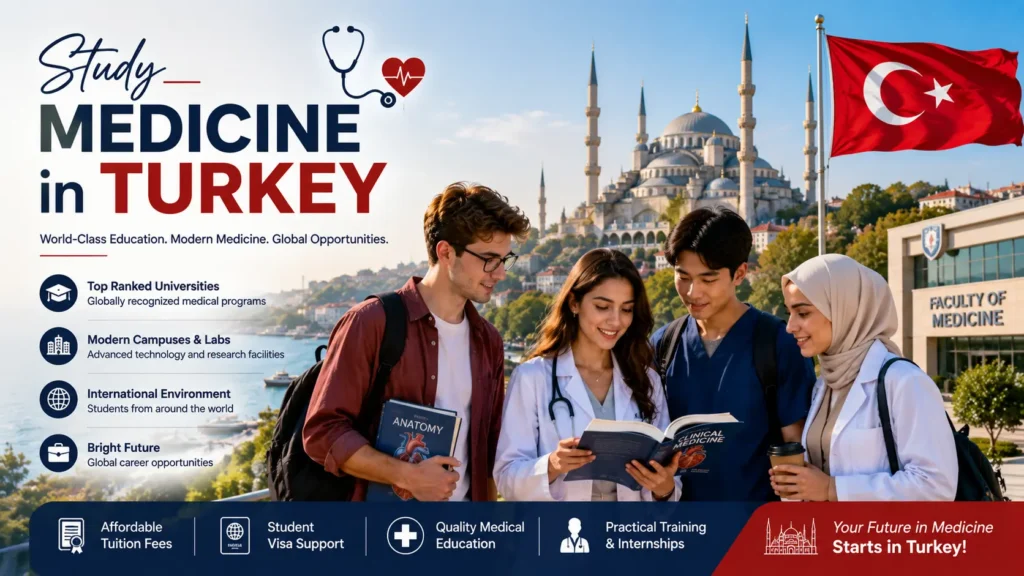

Turkey has established itself as a premier destination for international students pursuing a world-class medical education. The country offers a compelling synergy of academic rigor, state-of-the-art facilities, and a rich cultural tapestry all while remaining remarkably cost-effective. With globally recognized degrees and a commitment to contemporary teaching methodologies, Turkey provides an exceptional foundation for those aiming to build a successful medical career on a global scale.
Studying Medicine in Turkey at a Glance
Everything you need to know before applying to a medical university in Turkey, including study duration, tuition fees, language options and admission pathways.
Public universities usually have lower tuition fees but more competitive admission requirements. Private universities generally offer a simpler admission process for international students.
Public vs. Private Medical Universities
Public Universities
- Lower tuition fees
- Competitive admission
- TR-YÖS or SAT may be required
- Strong academic records are important
Private Universities
- More accessible admission
- Many English-taught programs
- Entrance exams often not required
- Higher tuition fees
Medical Study Path in Turkey
For aspiring physicians, choosing where to study is a monumental decision. Turkey offers a unique proposition: it acts as a strategic bridge between East and West, where a deep cultural heritage meets cutting-edge medical research. Significant national investment in healthcare infrastructure has transformed Turkey into a regional hub for medical training.
Whether in the dynamic metropolises of Istanbul and Ankara or in the more serene coastal cities, Turkish universities provide diverse environments that foster both academic excellence and personal growth. International students are increasingly drawn to these faculties for their comprehensive curricula, the availability of English-medium programs, and—most importantly—the invaluable clinical experience gained within highly equipped university hospitals. Ultimately, studying medicine in Turkey is more than just an academic pursuit; it is an immersive journey that shapes future healthcare professionals with a truly global perspective.
Why Study Medicine in Turkey? Strategic Advantages for Aspiring Doctors
The growing appeal of Turkey for medical students stems from a combination of strategic advantages that enhance both the educational experience and future career prospects. These benefits extend far beyond the classroom, encompassing economic, technological, and experiential dimensions that give students a competitive edge in the global healthcare market.
Quality Education Aligned with Global Standards
The Turkish medical education system is meticulously engineered to meet and exceed European and American academic benchmarks. This rigorous alignment with international standards ensures that graduates are not only competitive but fully prepared for the complexities of global healthcare. The curriculum is comprehensive, seamlessly blending foundational sciences with early clinical exposure, allowing students to cultivate both theoretical depth and practical agility from the very start of their program.
Furthermore, accreditation by national bodies such as TEPDAD (Turkish Medical Education Accreditation Board) and recognition within the World Directory of Medical Schools (WDOMS) solidify the credibility of Turkish degrees, streamlining the pathways for international licensing and professional practice.
Advanced Technologies and Modern Clinical Environments
A standout feature of Turkish medical education is the integration of cutting-edge technology. Universities boast sophisticated simulation labs that provide students with critical hands-on experience in controlled environments before they transition to patient care. Because university hospitals are often integrated directly with the medical faculties, students have immediate access to the latest diagnostic and treatment technologies.
These modern clinical settings offer an unparalleled opportunity to observe, assist, and eventually perform a diverse array of medical procedures under expert supervision. This level of exposure is essential for developing the competence and confidence required to thrive in a rapidly evolving global medical landscape.
Strategic Cost-Effectiveness Compared to Western Alternatives
One of the most compelling drivers for international students is the ability to access a world-class education at a fraction of the cost associated with Western Europe or North America. Whether at public or private institutions, tuition fees remain significantly more accessible than equivalent programs in many developed nations without any compromise in educational quality.
This affordability extends to the cost of living, where housing, dining, and transportation are considerably more manageable. This economic advantage democratizes high-quality medical education, easing the financial burden on students and allowing them to dedicate their full focus to academic excellence and personal growth.
Not sure which university or scholarship fits you?
Get a free assessment of your admission and scholarship chances from Saya Group advisors in Istanbul.
Book a free consultationThe Structure of Medical Education in Turkey: A Six-Year Roadmap
The journey to becoming a “Tıp Doktoru” (Medical Doctor) in Turkey is a structured six-year odyssey, designed to progressively build a student’s medical intuition and clinical competencies. This comprehensive curriculum is divided into these strategic phases:
Phase 1: Pre-Clinical Foundations (Years 1 to 3)
The first three years are dedicated to establishing an unwavering foundation in the basic medical sciences. Students immerse themselves in critical subjects including Anatomy, Physiology, Biochemistry, Histology, Microbiology, Pharmacology, and Pathology. This phase is primarily theoretical, delivered through a blend of intensive lectures, laboratory sessions, and small-group tutorials. The objective is to provide a profound understanding of human anatomy, the mechanisms of disease, and the core principles of medical intervention. By emphasizing interdisciplinary learning, the program ensures students develop a holistic view of human health before transitioning into clinical applications.
Phase 2: Clinical Immersion and Rotashions (Years 4 to 6)
The latter half of the program shifts from the classroom to the clinic, becoming intensely practical and patient-oriented. During the fourth and fifth years, students undergo rigorous rotations across various essential departments within university hospitals, including:
- Internal Medicine
- General Surgery
- Pediatrics
- Obstetrics and Gynecology
- Psychiatry
- Public Health
These rotations involve direct patient interaction, participation in ward rounds, complex case discussions, and attendance at surgical procedures or outpatient clinics. This phase is pivotal, as it allows students to translate theoretical knowledge into real-world patient care, refine their diagnostic intuition, and master complex treatment protocols.
The journey culminates in the sixth year: the full-time internship (Intörn Doktorluk). During this final year, students transition into the role of supervised junior doctors, assuming significant responsibility in patient management, performing minor medical procedures, and engaging in on-call duties. This immersive experience is the ultimate bridge, transforming the student into a confident, independent practitioner ready to enter the medical profession.
The Distinction of the “Tıp Doktoru” Title
Upon the successful completion of this rigorous six-year journey, graduates are conferred the title of “Tıp Doktoru.” Internationally, this qualification is equivalent to a Doctor of Medicine (MD) or a Bachelor of Medicine, Bachelor of Surgery (MBBS) degree. This title formally recognizes the individual as a qualified general physician. For those aiming for a specialized field, the subsequent step is the TUS (Tıpta Uzmanlık Sınavı), a competitive residency exam that opens the door to further specialization.
Thanks to the global recognition of their degrees and their intensive training, Turkish medical graduates are exceptionally well-positioned for diverse career trajectories, whether in clinical practice, academic research, or advanced specialization, both within Turkey and abroad.
Admission Requirements: Navigating the Pathways to Success
Gaining admission to a medical program in Turkey requires a strategic approach, as the requirements differ significantly between public and private institutions. For international applicants, understanding these nuances is the first step toward a successful application.
Public Universities: A High-Competition Environment
Admission to public medical universities is highly competitive, a reflection of their prestigious reputations and more affordable tuition fees. To secure a seat, international applicants must typically demonstrate an exceptional academic track record.
Standardized Testing: Most public universities require high scores on standardized entrance exams. The most prominent is the YÖS (Yabancı Uyruklu Öğrenci Sınavı), an exam specifically tailored for international students that assesses core competencies in mathematics and geometry. Some institutions also recognize competitive SAT scores.
Academic Standing: A high school GPA of 90% or higher is often seen as a prerequisite. However, due to the sheer volume of high-achieving applicants, a strong GPA alone does not guarantee admission.
The English-Medium Challenge: Competition is even more fierce for programs taught in English, often requiring near-perfect scores to be successful.
Private Universities: Flexible and Accessible Pathways
Private medical universities generally offer a more streamlined and accessible admission process, often prioritizing a holistic, file-based evaluation over rigid entrance exams.
Academic Criteria: While academic excellence is still a priority, the entry barriers are typically more flexible, with minimum high school GPA requirements often ranging between 70% and 80%.
Simplified Testing: Many private institutions do not mandate the YÖS or SAT, instead opting for their own internal aptitude assessments or a direct review of the student’s academic portfolio.
Language Proficiency: English proficiency remains a cornerstone. This can be verified through internationally recognized tests such as TOEFL or IELTS, or by passing the university’s own internal proficiency exam.
The Selection Process: Some private universities may include a personal interview as part of their final assessment to ensure a good fit between the student and the institution.
Given that popular programs in private universities fill up rapidly, early application is highly recommended. While the admission criteria may be more attainable than those of public universities, the quality of education, facilities, and clinical training remains exceptionally high, making them an ideal alternative for many international students.
Essential Documentation: Preparing Your Application Portfolio
Regardless of the institution, a meticulously prepared application portfolio is key to a successful admission. While specific requirements may vary by university, the following documents typically form the core of the application:
- High School Diploma: An official copy or its equivalent, professionally translated into English or Turkish and duly notarized.
- Academic Transcripts: Official mark sheets detailing your secondary education performance.
- Identification: A clear copy of your valid passport and your Turkish visa.
- Language Proficiency: For English-medium programs, a recognized certification such as TOEFL or IELTS, or a passing score on the university’s internal proficiency exam.
- Standardized Test Scores: YÖS or SAT results, where required by the specific university.
- Statement of Purpose (SOP): A compelling motivation letter outlining your aspirations and suitability for the medical profession.
- Letters of Recommendation: While often optional, these can significantly strengthen your profile and provide an edge over other candidates.
- Recent Photographs: Meeting the specific dimensions and requirements of the institution.
Because every university has its own unique nuances, it is critical to verify the exact requirements for each institution. Saya Group provides comprehensive, end-to-end guidance on the preparation and submission of these documents, ensuring your application is not only complete but strategically positioned for success.
Language of Instruction: Choosing between English and Turkish Tracks
One of the most pivotal decisions an international student must make is selecting the language of instruction. Both the English and Turkish pathways offer distinct advantages and challenges, and the choice should align with your long-term professional goals.
The English-Medium Pathway: Global Mobility and Professional Versatility
Pursuing medical studies in English is the most sought-after option for international students, primarily due to the unparalleled global mobility it provides. Degrees obtained through English-medium programs are generally more readily recognized and accepted by medical licensing boards and postgraduate institutions worldwide, including those in North America, the United Kingdom, and across Europe. By mastering complex medical terminology in a universally recognized language from day one, students gain a significant strategic advantage when preparing for prestigious international licensing exams, such as the USMLE (USA) or PLAB (UK).
While many private universities and a select few public institutions offer full English-medium tracks, this path comes with its own set of challenges. The competition for seats—especially in public universities—is intense, and the language proficiency requirements (TOEFL/IELTS) are stringent. Furthermore, it is important to note that while the academic medium is English, students must still acquire a functional level of Turkish to navigate daily life and, more critically, to communicate effectively with patients during clinical rotations.
The Turkish-Medium Pathway: Deep Immersion and Strategic Value
Choosing a Turkish-medium program often provides a distinct set of advantages, most notably more accessible tuition fees, particularly within public universities. Beyond the economic benefit, this pathway offers a deeper cultural immersion and a more seamless integration into Turkish society. From a clinical perspective, learning medicine in Turkish provides a significant edge. Since the vast majority of patients in Turkish hospitals communicate in the native language, fluency in Turkish facilitates superior patient-doctor interactions and a more profound understanding of local healthcare dynamics.
While this path requires a strong command of the language—typically verified through the TÖMER exam or a dedicated preparatory year of Turkish studies—the long-term rewards are substantial. Achieving fluency not only enriches the educational experience but is an invaluable asset for those considering a medical career within Turkey. Although mastering medical terminology in a new language presents an initial challenge, most universities provide extensive linguistic support to ensure international students succeed.
The Critical Role of Turkish in Clinical Settings
Regardless of whether the academic medium is English or Turkish, proficiency in the Turkish language becomes a non-negotiable requirement from the fourth year onward. As the curriculum shifts toward clinical rotations, patient interaction becomes the cornerstone of learning. Effective communication is vital for accurate history-taking, precise diagnosis, and building the essential rapport between doctor and patient.
Recognizing this, many universities integrate Turkish language courses into the medical curriculum, and students are strongly encouraged to pursue independent language studies. Embracing the Turkish language is more than a practical necessity; it is a gateway to understanding the local culture and forming meaningful professional connections within the healthcare system.
Tuition Fees and Cost of Living: A Comprehensive Outlook for 2025/2026
For any international student, understanding the financial commitment is paramount. While Turkey remains significantly more affordable than many Western destinations, a transparent breakdown of tuition and living expenses is essential for strategic planning.
Annual Tuition Fees (Estimated for 2025/2026)
Tuition for medical programs in Turkey varies considerably depending on the institution’s status (public vs. private), the language of instruction, and annual policy adjustments. Please note that the following figures are estimates. Because rates can fluctuate, we strongly recommend consulting the official university websites or contacting Saya Group for the most current and accurate pricing.
| University Type | Estimated Annual Tuition Fees (USD) | Payment Structure |
| Public Universities (Turkish Medium) | $3,000 – $8,000 | Typically 2 installments per academic year |
| Public Universities (English Medium) | $5,000 – $15,000 | Typically 2 installments per academic year |
| Private Universities (Turkish Medium) | $12,000 – $25,000 | Often 2-4 installments, some offer discounts for lump-sum payment |
| Private Universities (English Medium) | $15,000 – $35,000 | Often 2-4 installments, some offer discounts for lump-sum payment |
A Detailed Breakdown of Living Expenses
Beyond tuition, students must budget for their daily living costs. One of the primary advantages of studying in Turkey is that the cost of living is generally more accessible than in most European countries. However, expenses can vary significantly based on the city, your chosen lifestyle, and personal preferences. To provide a clear picture, here are the estimated monthly costs for a student maintaining a moderate and comfortable lifestyle:
Accommodation
Securing the right housing is a priority for every student. The options vary by budget and preference:
- University Dormitories: The most budget-friendly option, typically ranging from $100 to $300 per month. Please note that availability for international students can be limited and highly competitive.
- Private Student Residences: These offer enhanced amenities and more flexibility, with costs generally between $150 and $400 per month.
- Shared Apartments: A favorite for those seeking independence. In major hubs like Istanbul or Ankara, costs typically range from $250 to $600 per person, depending on the neighborhood and the number of roommates. Costs are generally lower in cities outside the major metropolises.
Dining and Groceries
A balanced approach to dining is the most economical way to manage expenses.
- Groceries & Home Cooking: Shopping at local markets and cooking at home is highly affordable, with monthly grocery bills typically between $150 and $250.
- Dining Out: Local eateries are surprisingly affordable, with individual meals ranging from $5 to $15.
- University Cafeterias: These offer the most cost-effective meal options on campus.
- Overall Food Budget: A realistic monthly budget, combining home cooking with occasional dining out, is approximately $200 to $350.
Transportation
Turkish cities boast extensive and efficient public transport networks. Students can take advantage of significant discounts using a dedicated student card. In cities like Istanbul, a monthly pass typically costs between $15 and $40, covering the metro, tram, bus, and ferries in coastal regions.
Health Insurance
Health insurance is a mandatory requirement for international students.
- State Health Insurance (SGK): Offering comprehensive coverage, this typically costs around $50 to $80 per month.
- Private Health Insurance: Basic plans start from approximately $20 to $50 per month, with more extensive coverage available at higher premiums.
Miscellaneous Expenses
This includes essential personal costs such as:
- Connectivity: Phone bills ($10–$20/month) and internet (often included in rent or roughly $15/month).
- Academic Supplies: Textbooks and materials ($50–$100 per semester).
- Leisure & Socializing: Entertainment and social activities ($50–$150/month).
- Total Misc. Estimate: Roughly $70 to $150 per month.
For an international medical student in a major Turkish city, a realistic total monthly budget—covering accommodation, food, transport, and personal expenses—ranges from $500 to $900. In smaller cities, this can drop to $400 to $700, making Turkey an economically sound choice for high-quality medical education.
Managing these costs effectively requires strategic planning. Saya Group provides tailored financial guidance and personalized cost breakdowns, ensuring you find the ideal balance between your budget and your academic aspirations.
Top Medical Schools in Turkey for International Students
Beyond tuition, students must budget for their daily living costs. One of the primary advantages of studying in Turkey is that the cost of living is generally more accessible than in most European countries. However, expenses can vary significantly based on the city, your chosen lifestyle, and personal preferences.
Top Public Medical Universities: Prestige and Academic Excellence
Turkey is home to a wealth of prestigious universities that offer world-class medical education, attracting an ever-growing community of international students. These institutions are renowned for their rigorous curricula, distinguished faculty, and state-of-the-art facilities.
Below is a curated look at some of the top medical schools, categorized by the public and private sectors.
- Hacettepe University (Ankara): A powerhouse of medical research and clinical excellence. Consistently ranked as one of Turkey’s top medical schools, Hacettepe is acclaimed for its rigorous training and vast university hospital network. It offers both Turkish and English-medium programs, making it a prime choice for those seeking a high-intensity academic environment.
- Istanbul University (Cerrahpaşa & Istanbul Faculty of Medicine): These two historically significant faculties are pillars of medical education in Turkey. Known for their immense clinical resources and rich heritage, they provide students with an unparalleled volume of diverse patient cases and research opportunities.
- Ankara University: As one of the nation’s most respected institutions, its Faculty of Medicine is renowned for balancing a formidable theoretical foundation with early clinical immersion. While primarily Turkish-medium, it remains a gold standard for medical training in the capital.
- Ege University (Izmir): Situated in the vibrant coastal city of Izmir, Ege University is celebrated for its modern facilities and a supportive academic ecosystem. It is a leader in medical research and offers a comprehensive curriculum that prepares students for global practice.
- Gazi University (Ankara): Renowned for its disciplined academic approach and extensive practical training, Gazi University focuses on producing ethically grounded and highly competent physicians. Its state-of-the-art facilities provide a robust setting for medical mastery.
Top Private Medical Universities: Innovation and Global Perspectives
Private universities offer a more flexible admission process and a strong emphasis on English-medium instruction, making them highly attractive to the international community. While tuition is higher, the investment is reflected in smaller class sizes and cutting-edge infrastructure.
- Koç University (Istanbul): A beacon of prestige and innovation. Koç University is distinguished by its commitment to evidence-based medicine, cutting-edge research, and global collaborations. With a full English-medium program and world-class facilities, it is designed for the elite aspiring physician.
- Acıbadem University (Istanbul): Integrated with the renowned Acıbadem Healthcare Group, this university offers a uniquely practical, clinic-centric education. Students benefit from direct access to a premier network of modern hospitals, ensuring an education that is as practical as it is theoretical.
- Bahçeşehir University (Istanbul): Focused on global mobility, Bahçeşehir provides a contemporary medical education with an international outlook. Its English-medium program and advanced simulation centers are specifically designed to prepare students for careers in the global healthcare market.
- Istanbul Medipol University: A rapidly ascending leader in medical education, Medipol is known for its own massive university hospitals. Offering both English and Turkish tracks, it emphasizes high-volume practical training and attracts a diverse international student body.
- Yeditepe University (Istanbul): Celebrated for its holistic approach to medicine, Yeditepe combines a rigorous scientific curriculum with a strong emphasis on medical ethics. Its modern campus and English-medium programs provide a balanced and supportive environment for growth.
When selecting the ideal institution, prospective students should carefully evaluate several critical factors: the language of instruction, specific admission requirements, faculty expertise, research opportunities, and the clinical environment and strategic clinical affiliations that align with their long-term career aspirations. Choosing the right institution is not just about prestige, but about finding a university whose clinical partnerships and hospital network provide the specific practical exposure you need to excel in your chosen medical specialty.
Life After Graduation: Global Career Horizons
A medical degree from a recognized Turkish institution is far more than a qualification; it is a passport to a multitude of prestigious career pathway, both within Turkey and across the globe. The rigorous training and international recognition of Turkish medical universities empower graduates to seamlessly integrate into diverse healthcare systems worldwide.
The American Dream: Navigating the USMLE Pathway
For those aspiring to practice in the United States, the journey is structured around the United States Medical Licensing Examination (USMLE). This is a high-stakes, three-step process that demands excellence and precision.
- Certification & Eligibility: The first critical step is ensuring that your degree is from a university listed in the World Directory of Medical Schools (WDOMS) and eligible for ECFMG (Educational Commission for Foreign Medical Graduates) certification. The majority of accredited Turkish universities meet this global standard.
- The Road to Residency: After successfully passing USMLE Step 1 and Step 2 CK (Clinical Knowledge), graduates obtain their ECFMG certificate. This certification is the key that allows them to apply for residency positions via the Electronic Residency Application Service (ERAS).
While the path is competitive, the high quality of foundational education in Turkey ensures that many graduates successfully secure prestigious residency placements in the US every year.
The UK and Europe: PLAB and Strategic Recognition
Graduates targeting the United Kingdom or the European Union find that Turkish degrees are generally well-regarded and respected.
The United Kingdom: The primary route is through the PLAB (Professional and Linguistic Assessments Board) test. Upon passing these exams, graduates can apply for registration with the General Medical Council (GMC), granting them the legal right to practice in the UK.
European Union: Although Turkey is not an EU member, it is a signatory to the Lisbon Recognition Convention, which significantly streamlines the recognition of academic qualifications.
The German Model: In Germany, for example, the process typically involves obtaining a Berufserlaubnis (provisional license), followed by the Approbation (full license). This usually requires German language proficiency and a professional equivalency assessment.
The robust clinical training received in Turkey provides a formidable advantage in passing these rigorous European licensing examinations.
Expanding Horizons: The Gulf Region and Beyond
The Middle East, particularly the GCC countries (UAE, Saudi Arabia, and Qatar), presents lucrative opportunities for Turkish medical graduates. Healthcare authorities—such as the DHA (Dubai), SCFHS (Saudi Arabia), and QCHP (Qatar)—highly value Turkish medical credentials.
Interestingly, a strong performance in the USMLE can often expedite the licensing process in these regions, as their standards are closely aligned with international benchmarks. Furthermore, the global partnerships fostered by Turkish universities provide graduates with an expansive professional network, making them highly competitive candidates in any international healthcare market.
Specializing Within Turkey: The TUS Gateway
For those who choose to build their career within the Turkish healthcare system, the TUS (Tıpta Uzmanlık Sınavı) is the definitive gateway. The Turkish Medical Specialization Examination is a highly competitive national contest open to all medical graduates, including international students. Success in the TUS grants access to residency programs across a vast array of specialties. While the exam is notoriously challenging and requires intensive preparation, it is the gold standard for those aspiring to become specialist physicians in Turkey.
It is paramount to understand that while a medical degree (MD) from an accredited Turkish university provides a formidable academic foundation and the global recognition necessary for eligibility, it is the first step in a larger journey. Every country maintains its own unique set of licensing requirements, professional exams, and legal procedures that must be meticulously fulfilled to practice medicine. Navigating these complex international pathways, from the USMLE in the United States to the Approbation in Germany or the GMC registration in the UK—can be an overwhelming task for any graduate.
This is where Saya Group becomes your strategic partner. We don’t just assist with admissions; we provide expert, end-to-end guidance to help you navigate these intricate global transitions. From choosing the right university that aligns with your future licensing goals to understanding the nuances of international medical boards, we ensure that your transition from student to globally recognized physician is seamless and successful.
Challenges and Realities: A Transparent Perspective
While the advantages of pursuing a medical degree in Turkey are compelling, a journey of this magnitude comes with its own set of inherent challenges. At Saya Group, we believe in providing an honest and transparent outlook. Understanding these realities is not meant to discourage, but to empower you to prepare strategically and manage your expectations effectively.
The Competitive Landscape of Public Universities
Aspiring to join a public medical faculty in Turkey is a pursuit of prestige and affordability, but it is also a journey through exceptionally high competition. Due to their long-standing reputations and accessible tuition, these institutions attract a global pool of elite applicants.
This results in a highly stringent admission process. Securing a seat, particularly in English-medium tracks, often requires near-perfect scores in exams such as the YÖS or SAT, coupled with an exemplary academic record. It is important to recognize that meeting the minimum criteria does not always guarantee acceptance. Therefore, we strongly advise students to maintain a strategic approach, including a well-considered backup plan that may involve top-tier private universities or alternative international options.
The Rigor of Clinical Rotations and the Language Imperative
The transition from the classroom to the clinic (Years 4 through 6) is perhaps the most demanding phase of medical education. This period is characterized by extended hours, intense academic pressure, and a profound shift in responsibility as you move from theoretical knowledge to direct patient care. The most critical reality of this phase is the Language Imperative. While your textbooks and professors may speak English, your patients speak Turkish.
The ability to take a precise medical history, understand a patient’s nuance, and explain a complex diagnosis is impossible without a strong command of the Turkish language. This linguistic barrier, if not addressed proactively from the first year, can become a significant hurdle to your clinical performance and learning. The dual challenge of mastering a complex medical curriculum while simultaneously achieving fluency in a new language is formidable. However, those who commit to rigorous language study early on find that this challenge becomes their greatest asset, allowing them to fully immerse themselves in the invaluable clinical experience that Turkish hospitals provide.
Frequently Asked Questions
What are the specific weightings of YÖS scores for different medical schools?
YÖS score weightings vary by university and faculty; there is no standardized weighting across all medical schools.
Are there any hidden administrative fees beyond tuition in private universities?
Some private universities may have additional registration or administrative fees; always check the university’s official fee schedule or consult Saya Group for details.
How does the WDOMS status affect a graduate’s eligibility for licensing exams in the Middle East?
WDOMS listing is crucial for eligibility to sit licensing exams in the Middle East, as it verifies the medical school’s international recognition.
Can a student transition from a Turkish-medium program to an English-medium one mid-degree?
Transitioning between language mediums mid-degree is generally difficult and rarely permitted, often requiring reapplication or extensive language proficiency proof.
What legal documentation is required specifically for foreign medical interns in Turkish state hospitals?
Foreign medical interns typically need a valid student visa, a residency permit, and sometimes specific departmental permissions or health clearances for state hospitals.
How long does it take to study medicine in Turkey?
Studying medicine in Turkey typically takes 6 academic years, comprising 3 theoretical years and 3 practical/clinical years.
What are the main advantages of studying medicine in Turkey?
Key advantages include high-quality education, advanced facilities, global recognition of degrees (for licensing pathways), and relatively affordable tuition and living costs.
What are the primary disadvantages of studying medicine in Turkey?
Disadvantages include intense competition for public university seats and the necessity of learning Turkish for clinical practice.
Is it possible for foreign graduates to work as doctors in Turkey after studying?
Yes, recent legal amendments allow foreign graduates from Turkish universities to work as doctors in Turkey after fulfilling specific requirements.
Is it easy to get admission to study medicine in public universities in Turkey?
No, admission to public medical universities is highly competitive and difficult due to high demand and strict requirements.
How can I increase my chances of admission to Turkish public medical universities?
Achieving very high scores in the YÖS or SAT exam and having an excellent academic record significantly increases your chances.
Is admission guaranteed in private medical universities in Turkey?
Admission to many private medical universities is highly probable and often achievable with good academic standing and meeting specific criteria.
Are there scholarships available for studying medicine in Turkey?
Yes, scholarships are available, including the Turkish government’s Türkiye Bursları and various university-specific scholarships, some of which can be fully funded.
What is the typical medical acceptance rate in Turkey?
Acceptance rates vary significantly; public universities often require above 90% in entrance exams, while private universities may accept high school averages above 70%.
Can one study medicine in Turkey for free?
Studying medicine for free is possible through fully funded scholarships like Türkiye Bursları, though competition for these is extremely high.
What are the core medical subjects taught in Turkey?
Core subjects include Anatomy, Physiology, Biochemistry, Histology, Microbiology, Pharmacology, Pathology, and clinical rotations in various specialties.
When does practical training in hospitals begin for medical students?
Practical training and clinical rotations in hospitals typically commence in the fourth year of the medical program.
What are the approximate costs of studying medicine in public universities?
Annual tuition fees for public universities generally range from $3,000 to $15,000, depending on the language of instruction.
What are the approximate costs of studying medicine in private universities?
Annual tuition fees for private universities range from $15,000 to $35,000, depending on the university and program language.
Is it possible to study medicine in Turkey in English?
Yes, many private universities and a few public universities offer medical programs taught entirely in English.
Can I study medicine in Turkey without taking the YÖS exam?
Yes, many private universities accept students based on high school diploma and other criteria without requiring the YÖS exam.
What are the languages of study for medicine in Turkey?
Medical programs in Turkey are primarily offered in either Turkish or English, depending on the university and faculty.
Is studying medicine in Turkey considered difficult?
Yes, studying medicine in Turkey is considered rigorous and demanding, comparable to Western standards due to the high academic and practical requirements.
Are medical degrees from Turkey recognized internationally?
Yes, Turkish medical degrees are globally recognized, particularly for eligibility to pursue licensing pathways in Europe and the West, as most accredited universities are listed in the WDOMS.
Is it possible to study medicine in Turkey in Arabic?
No, there are no Turkish universities that offer medical programs taught in Arabic.
Which is considered the best medical university in Turkey?
While many universities excel, Hacettepe University in Ankara is frequently cited as one of the top medical universities in Turkey for its research and clinical facilities.
Is medical education in Turkey considered advanced?
Yes, medicine in Turkey is highly advanced, encompassing both academic excellence and practical, research-oriented innovation in the medical field.
Choosing a university? See our list of the best medical universities in Turkey, check current medical tuition fees in Turkey, and learn how to win a medical scholarship in Turkey.
Before choosing a university, check whether Turkish degrees are recognised in the country where you want to work.
Conclusion
Embarking on the journey to study medicine in Turkey is more than just an academic choice; it is a strategic decision to invest in a future defined by high-quality education, unparalleled clinical exposure, and a globally recognized degree. By blending a rigorous six-year curriculum with a culturally rich and economically viable environment, Turkey provides a comprehensive ecosystem for the next generation of medical professionals
While the path demands resilience—whether in navigating the fierce competition of public universities or mastering the Turkish language for clinical excellence—these challenges are entirely manageable with the right mindset, diligent preparation, and expert guidance. The vast global opportunities awaiting graduates, through pathways like the USMLE, PLAB, or TUS, are a testament to the strength and prestige of the Turkish medical education system
Making an informed decision about your university, language of instruction, and financial planning is the most critical step in this journey. You do not have to navigate these complexities alone. Saya Group stands as your dedicated partner and strategic consultant. We are committed to guiding you through every nuance of this significant transition, from identifying the ideal university that aligns with your aspirations to managing the intricate admission requirements and securing your place
Our mission is to illuminate your path, removing the obstacles and unlocking your full potential. Let us help you realize your dream of studying medicine in Turkey, paving the way for a fulfilling, prestigious, and impactful medical career. Your journey toward excellence begins here. With Saya Group, the world of medicine is within your reach
Related reading
Need personalised advice? Get a free consultation from the Saya Group team.