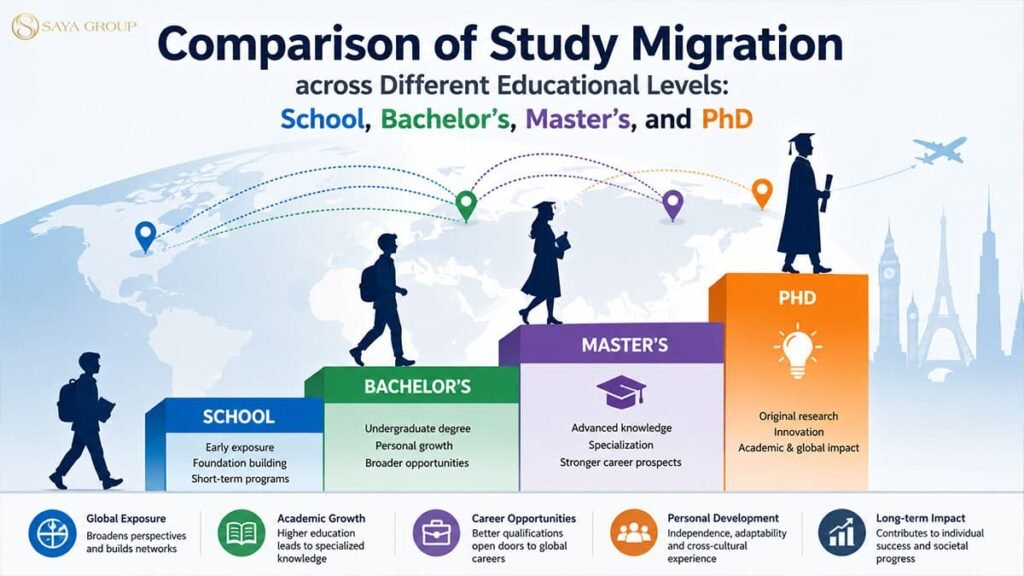

Academic migration is one of the most popular pathways for entering another country. A journey that can enhance an individual’s academic levels and skills while significantly impacting their future career and residency pathway. However, there is a crucial factor in this process: choosing the right educational level.
An individual’s age and objectives when pursuing education abroad can completely alter the final outcome. Some enter the destination country’s educational system at the school level, while others decide to migrate for an undergraduate degree (Bachelor’s). Another group chooses to pursue a Master’s degree, and some opt for a PhD with a focus on research and a long-term academic career.
In fact, academic migration is not merely about choosing a country or a university; rather, the chosen educational level determines the cost of living and tuition, admission difficulty, scholarship opportunities, part-time work permits, post-graduation residency prospects, and even the individual’s lifestyle in the destination country. Therefore, to make an informed decision, one must understand the differences between these levels and be aware of the advantages and limitations of each.
| Educational Level | Primary Goal | Estimated Duration | Estimated Cost | Funding/Scholarship Chance | Key Requirements |
| School | Language and cultural immersion, University prep | 3-6 Years | High | Low | Guardianship, Study Permit |
| Bachelor’s | Foundational degree, Starting an international career | 3-4 Years | Moderate to High | Moderate | Language Certificate, GPA, SOP |
| Master’s | Career advancement, PhD prep | 1-2 Years | Moderate to High | High | Language Certificate, GPA, CV/Resume |
| PhD | Research, Knowledge production, Academic standing | +3-5 Years | Low (with Funding) | Very High | Research Proposal, Research CV |
School-Level Academic Migration
Academic migration at the school level is typically pursued by students who have not yet entered university, and whose families intend for them to study in a more international, high-quality, or future-oriented educational system. This stage can encompass primary, middle, or high school education. In many countries, international, private, or boarding schools are the primary options for international students.
Key Features of School-Level Academic Migration
At this stage, students enter a new environment at an early age, providing them with the opportunity to naturally acquire the language, culture, and educational approach of the host country. This exposure ensures a much smoother integration into the new society in the future. Many families choose this level so their children can grow within a modern, skills-based, and international educational system from the very beginning.
Not sure which university or scholarship fits you?
Get a free assessment of your admission and scholarship chances from Saya Group advisors in Istanbul.
Book a free consultationBenefits of Academic Migration at the School Level
One of the most significant advantages of schooling abroad is early language acquisition. When a child or teenager is immersed in an environment where they hear and use the country’s primary language every day, the learning process becomes much faster and more intuitive. This proficiency has a profound impact on their future academic and professional prospects.
Another key advantage is early exposure to diverse cultures. Students who interact with classmates of various nationalities from childhood develop superior communication skills, flexibility, and cross-cultural understanding from the start. In today’s world, these attributes are highly valuable.
Furthermore, schooling abroad can pave the way for easier admission to prestigious universities in the host country. A student who has spent years within the destination’s educational system is typically familiar with its standards, expectations, and assessment methods, which gives them a distinct advantage in the university admissions process.
Limitations of School-Level Migration
Despite these advantages, this stage involves significant limitations. The most critical challenge is separation from family. Many students at a young age lack the emotional readiness for independent living in a foreign country, which can lead to homesickness, anxiety, or a decline in academic performance.
Costs at this level are also typically high, private and boarding schools in most countries charge substantial tuition fees. Beyond tuition, expenses such as accommodation, guardianship, insurance, transportation, and daily living costs must also be considered. Moreover, families must navigate the legal and administrative requirements for guardianship, supervision, and student visas. In some countries, the absence of a legal guardian or incomplete documentation can significantly complicate the admission process.
Who is it suitable for?
School-level migration is most suitable for families who:
- Have the financial capacity to cover the costs
- Intend for their child to become familiar with international languages and cultures at an earlier age
- Are focused on their child’s long-term academic and residency prospects
- Have a child who is emotionally and personally prepared to live in a new environment
Undergraduate-Level Academic Migration
The undergraduate level is one of the most common and logical stages to begin educational migration. At this stage, individuals typically enter a university in their destination country after finishing high school, experiencing independent student life for the first time. A bachelor’s degree generally takes 3 to 4 years to complete, although this duration may vary depending on the country and the specific field of study.
Key Features of Undergraduate Academic Migration
At this level, the primary focus is on providing both foundational and specialized education in the chosen field. From the very beginning, students embark on a clear academic path, gaining the opportunity to prepare for an international career from a young age. Consequently, many individuals aiming to build a robust academic and professional future choose the undergraduate stage to start their journey.
Benefits of Academic Migration at the Undergraduate Level
One of the most significant advantages of this level is access to world-renowned universities. Many countries offer high-quality undergraduate programs, modern educational facilities, and strong connections to the global job market.
Another key advantage is the experience of true independence. During this period, students learn how to manage their own lives, take on responsibilities, build new connections, and thrive in a competitive environment. This experience offers more than just an academic degree; it brings a form of personal maturity.
In terms of career prospects, pursuing an undergraduate degree abroad can significantly enhance one’s chances of entering the international job market. Many employers place greater trust in candidates who have earned their degrees from reputable countries, especially if the individual has also acquired practical skills, language proficiency, and student work experience during their studies.
Limitations of Undergraduate Level Migration
However, this level also comes with its own challenges. One of the most significant is the requirement for an acceptable language proficiency certificate. In many countries, admission without a language degree or with a low level of proficiency is either limited or conditional.
Additionally, university tuition fees and living expenses in the destination country can be high. Since students typically do not yet have a steady income, families must have meticulous planning to cover these costs.
Another issue is the competition for admission to top-tier universities. In addition to the GPA, prestigious universities usually consider the academic resume, language scores, the Statement of Purpose (SOP), and sometimes standardized tests. Therefore, gaining admission at the undergraduate level is not always straightforward.
Who is it suitable for?
This Level is ideal for individuals who:
- Have recently obtained their high school diploma or are on the verge of entering university.
- Aim to grow within the host country’s educational system from the very beginning.
- Are looking to build an international career.
- Have the financial means or scholarship support to cover university tuition and expenses.
Master’s Level Academic Migration
The Master’s degree is one of the most popular levels for academic migration; at this stage, individuals typically have clearer goals and seek to deepen their specialized knowledge. In most countries, this program lasts between one to two years and can be offered as research-based, course-based, or a combination of both.
Key Features of Master’s Level Academic Migration
At this stage, students typically focus on a specific niche rather than the broad and general education found in undergraduate programs. This increased specialization better prepares individuals for the job market, advanced research, or pursuing a PhD.
Benefits of Academic Migration at the Master’s Level
The most significant advantage of this level is the enhancement of expertise and professional credibility. An individual who earns a Master’s degree from a prestigious international university typically secures a better position in the job market and builds a more competitive resume.
The next advantage is the opportunity to receive scholarships and funding. Although securing a scholarship is not easy in all fields or countries, the chances of obtaining financial aid are higher at the Master’s level—especially in research-based programs or specific universities—compared to undergraduate studies.
On the other hand, this level serves as a crucial springboard for those intending to pursue a PhD. If a student manages to produce publications, projects, or a strong thesis, and establishes solid academic connections with professors during their Master’s, the path to a PhD becomes significantly smoother.
Limitations of Master’s Level Migration
Despite the numerous benefits, the Master’s level is not without its challenges. One of the most significant limitations is the high competition for admission to prestigious universities and for securing scholarships. Factors such as a solid GPA, language proficiency certificates, a compelling Statement of Purpose (SOP), and sometimes research experience are of great importance.
Another challenge is the academic and research pressure. At the Master’s level, students are expected to demonstrate higher analytical skills, undertake more demanding projects, and devote significant time to their thesis or dissertation.
Furthermore, if an individual applies without funding, the costs can be substantial, especially in countries where university tuition fees and living expenses are high.
Who is it suitable for?
This Level is ideal for individuals who:
- Hold a Bachelor’s degree and seek to enhance their specialized expertise.
- Are looking for professional or academic growth.
- Intend to pursue a PhD or a career in research.
- Possess a relatively stronger resume compared to those at lower academic levels.
PhD Level Academic Migration
A PhD (Doctorate) is the highest level of university education and is primarily suited for individuals whose main objectives are research, knowledge contribution, and academic pursuits. This degree typically lasts between 3 to 5 years—or even longer—and its core focus is centered on independent research, publishing scholarly articles, and defending a doctoral dissertation.
Key Features of PhD Level Academic Migration
In a PhD program, the student is no longer merely a consumer of knowledge but must play an active role in producing new knowledge. Consequently, the choice of supervisor, research area, and host university is of paramount importance. Unlike undergraduate admissions, which are primarily based on general credentials, PhD admission is determined by the academic connection with a professor and the alignment of the research topic with the university’s expertise.
Benefits of Academic Migration at the PhD Level
One of the greatest advantages is securing a full fund or scholarship. In many countries, PhD students not only receive tuition waivers but also a monthly stipend. This financial support often makes a doctorate more attractive than a Master’s degree from a financial perspective.
Another advantage is the high level of academic and professional prestige. Those who earn a PhD typically secure excellent positions in university teaching, advanced research, specialized consulting, and high-level organizational roles.
Furthermore, a PhD can have a positive impact on one’s future career and immigration prospects, as in many countries, doctorate holders benefit from higher academic and professional points.
Limitations of PhD Level Migration
However, a PhD is also the most challenging and critical level of academic migration. First and foremost, the admission process is highly competitive. Finding a suitable supervisor, drafting a compelling research proposal, and possessing a solid research resume are by no means easy tasks.
On the other hand, this level demands immense patience, perseverance, and high psychological resilience, as research projects can be lengthy, complex, and sometimes exhausting. Many students experience mental pressure, loss of motivation, or delays in completion midway through their journey.
Furthermore, if adequate funding is not secured, the costs of living and research can be burdensome. Consequently, without meticulous planning, a PhD may turn into a significant challenge rather than an opportunity.
Who is it suitable for?
This Level is ideal for individuals who:
- Those with a genuine passion for research and academic activities.
- Holders of a relevant Master’s degree.
- Individuals with a research background, published papers, or scientific projects.
- Those aiming for a career in academia, teaching, or advanced research.
Comparison of Pros and Cons for Each Level
If we compare the different levels of academic migration, each occupies a distinct stage of life and planning.
1-School Level
Pros:
- Language learning from a young age
- Greater cultural adaptation
- Better preparation for entering universities in the destination country
Cons:
- Dependence on family
- High costs
- Need for more supervision and care
2-Undergraduate Level
Pros:
- A strong foundation for future academic and professional paths
- Experiencing independence
- Opportunity to enter the international job market
Cons:
- Requirement for language proficiency certificates
- Significant costs
- Competitive admission process
3-Master’s Level
Pros:
- Specialization
- Better chances for scholarships
- Preparation for the job market or PhD
Cons:
- Academic and research pressure
- Need for a stronger resume
- Higher competition
4-PhD Level
Pros:
- Highest academic prestige
- Possibility of full funding
- Research and academic opportunities
Cons:
- Difficult admission process
- Requirement for long-term commitment
- High psychological and academic pressure
Which level is right for you
Choosing the best level depends entirely on your goals, age, budget, language proficiency, and future plans. If you or your child are at a young age and intend to grow within the destination country’s educational system from the start, the school level could be an excellent choice. If you have recently graduated from high school and wish to enter a foreign university from the foundational level, a Bachelor’s degree is the more suitable option.
If you already hold a university degree and are seeking further specialization, better career opportunities, or a path toward a PhD, a Master’s degree could be the best choice. And if your goal is research, academic teaching, or attaining a high scholarly standing, a PhD will be your primary option.
In general, no single level is “the best” for everyone; rather, the best level is the one that aligns with your individual circumstances and long-term goals.
Conclusion
Academic migration at different levels offers a variety of opportunities. The school level is ideal for an early start and deep immersion in the language and culture. A Bachelor’s degree is considered a key option for those who wish to build an international academic and career path from the beginning. A Master’s degree is suitable for individuals seeking specialization, professional growth, and the possibility of receiving scholarships. Finally, a PhD is the best choice for those passionate about research, teaching, and reaching high academic standing.
If you plan to apply for academic migration, first and foremost, you must clarify your goals, evaluate your budget, and assess your language proficiency and resume. Only then should you choose the right country and educational level. Making the right decision at the beginning of this journey can profoundly transform your academic and professional future.
Still choosing a country? Compare the top study abroad destinations for 2027 and see how to study abroad without IELTS.
Frequently Asked Questions
Is academic migration at the school level suitable for young children?
Yes, if the family can provide the necessary support and the child is emotionally prepared, this level can lay the foundation for a brilliant future. However, it requires a careful assessment of the individual circumstances of both the child and the family.
Can I apply directly for a Master’s degree with only a high school diploma?
No. Typically, to be admitted to a Master’s program, you must have completed a Bachelor’s degree and hold its certification.
Which level has the highest chance of receiving a scholarship?
The PhD level offers the highest chance of receiving a full scholarship (funding), as research projects are often financed by universities or research centers. Master’s programs also offer good opportunities for partial scholarships or grants.
Does studying abroad at the school level guarantee admission to universities in the same country?
There is no absolute guarantee, but studying in the destination country’s schools significantly increases your chances. This is due to familiarity with the educational system and the possibility of obtaining strong recommendation letters from teachers.
How long does academic migration for a Bachelor’s degree take?
Depending on the country and its educational system, it typically takes between 3 to 4 years.
Does academic migration at the PhD level involve costs?
If you secure funding or a scholarship, your tuition and living expenses will be covered. Otherwise, the costs can be high, although they are generally not comparable to (often less than) the costs of lower educational levels.
Related reading
- Study in Turkey: the complete guide for international students
- Study immigration to Germany
- Study immigration to France
Need personalised advice? Get a free consultation from the Saya Group team.