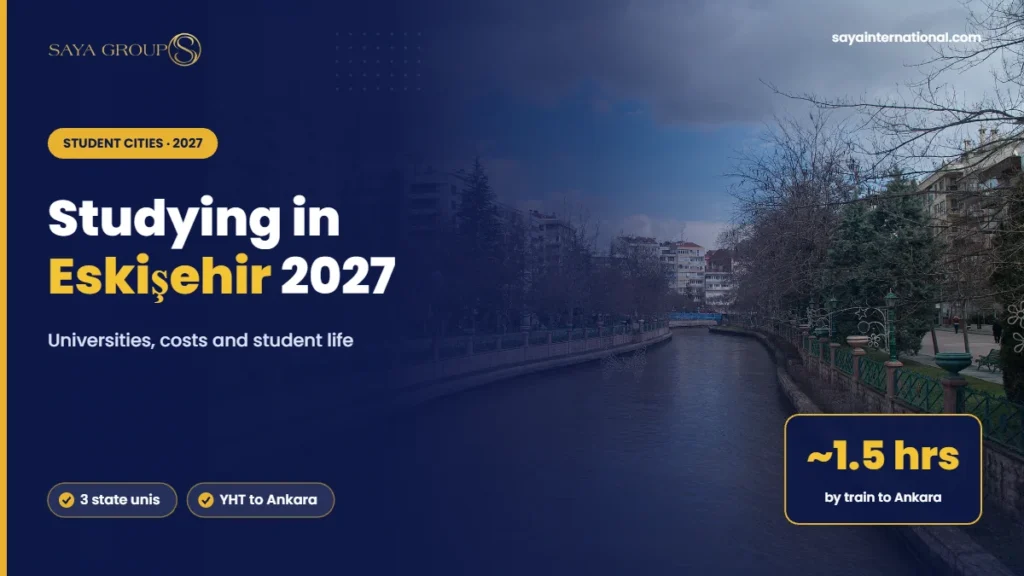


Most people who apply to study in Turkey do not have a clear picture of the path. There is a lot of scattered information on the internet, but what is really useful is practical experience things that are usually neither mentioned in consultation sessions nor referred to precisely on websites.
Why study in Turkey?
At first glance, most applicants pay attention to the low cost or geographical proximity, but experience shows that the real reasons are somewhat deeper.
• Turkey has a combination of a European and local educational system, and many universities follow the Bologna Process.
• It is possible to study in two languages, Turkish and English, but English programs are usually more competitive and more expensive.
• Obtaining a student residence permit is relatively simple, and the path to converting it into a work residence, although difficult, is achievable.
• Turkey’s geographical location makes it close to the regional and even European job market.
Main application pathways
When you enter this path, you are practically faced with three main routes, and choosing correctly between them is very important.
• Direct application through universities: suitable for those who are in a hurry or do not want to enter intense competition. (Admission to private universities in Turkey)
• Turkish government scholarship: an ideal option but highly competitive.
• Admission through the TRYÖS or SAT exams for higher-level universities.
Each of these paths has its own strategy, and it is not possible to apply a single approach to everyone.
Not sure which university or scholarship fits you?
Get a free assessment of your admission and scholarship chances from Saya Group advisors in Istanbul.
Book a free consultationThe Reality of Turkish Scholarships (Türkiye Bursları)
The biggest mistake applicants make is thinking that they can obtain this scholarship only with a high GPA.
Whereas in practice, the applications that get accepted share several common characteristics:
• A strong and personalized motivation letter
• A real résumé (not merely translated documents)
• A logical connection between the previous field of study and the new choice
• A clear objective for studying in Turkey
If you do not have these, even with a high GPA you do not have much chance.
Required Documents (What Really Matters)
On the surface, the documents are clear, but what matters in the final evaluation is different.
Basic documents:
• Diploma and transcripts (official translation)
• Passport
• Personal photo
• Language certificate (if available)
Decisive documents:
• Statement of Purpose (SOP)
• Recommendation letter
• Curriculum Vitae (CV)
In real experience, it is the second category that determines the outcome, not merely the translated documents.
Student Life in Turkey
Student life in Turkey is a combination of positive experiences and challenges, and you should see both.
• The student community is large, and you have good networking opportunities.
• Urban and university facilities in most cities are acceptable.
But alongside these:
• Learning the Turkish language is almost essential, even if your program is in English.
• Finding a student job is not easy.
• The quality of education is not the same in all universities.
Costs of Student Life in Turkey
One of the most important questions is always the cost, but the figures you see in online articles are usually not accurate.
• Tuition at public universities is usually between 300 and 1500 dollars per year.
• Private universities can have tuition fees between 3000 and 45000 dollars. (It varies depending on your chosen field and university)
• Living expenses vary between 500 and 1000 dollars per month, depending on the city and lifestyle.
The important point here is that the choice of city has a very significant impact on the final cost. Istanbul is not always the best choice.
Common Mistakes of Applicants
Over the years, a series of mistakes has been repeated among most applicants:
• Choosing a university based only on its name
• Ignoring the Turkish language
• Applying too late
• Relying on outdated or incomplete information
These simple mistakes can affect the entire process.
A Real Strategy for Success
If I want to summarize the experience, the successful path is usually like this:
• Clearly define your goal (study, immigration, or residence)
• Choose one main path and focus on it
• Always have an alternative option
• Start learning the Turkish language from the beginning
Studying in Turkey is a good path, but only when you move forward with a realistic view. The difference between acceptance and rejection is usually in the details not in the generalities.
If you proceed on this path in a principled way, it can be the starting point of a serious future for you.
Turkey’s Education System
Many applicants take action without properly understanding Turkey’s education system, and this causes them to make wrong choices. Understanding this part, before applying, is considered a serious advantage.
Academic Levels in Turkey
Turkey’s education system follows the structure of the Bologna Process, but in practice it has a number of important differences that you should know.
In general, the study path is as follows:
• Bachelor’s (Lisans): usually 4 years
• Master’s (Yüksek Lisans): 2 years (with thesis or without thesis)
• PhD (Doktora): between 3 to 5 years
But a point that is very important in practice:
Many international students first enter a one-year language program (Hazırlık). This course is mandatory if your language has not reached the required level.
This means that in reality your path may become like this:
Actual study + one year of language
This directly affects your time and even your cost.
The Role of YÖK in Turkey’s Education System
One of the important differences between Turkey and many countries is the existence of a powerful central institution called YÖK.
YÖK (Council of Higher Education of Turkey) is practically the main policymaker of universities, and its role is not only supervisory, but also decision-making.
In practice, this means:
• Approval of fields of study and educational programs is carried out by YÖK
• Standardization of the university system is under the supervision of this institution
• Recognition of foreign degrees (Denklik) is carried out through YÖK
An important practical point:
Many of the problems that students face after entering Turkey (such as changing major, recognition, or transfer) are directly or indirectly related to YÖK.
Therefore, understanding this institution is not just general information—it has an impact on your real decisions.
Planning your application? Compare university tuition fees in Turkey, see how to study in Turkey without YÖS, and prepare your Turkey student visa and residence permit. On a budget? Start with the cheapest universities in Turkey and our 100% scholarship in Turkey guide.
Next steps: follow our guide on how to apply to Turkish universities, browse the best English-taught programs in Turkey, and read about studying in Istanbul.
More guides: student health insurance in Turkey, studying in Ankara and diploma equivalence (denklik) in Turkey.
Languages of Instruction in Turkish Universities
One of the frequently asked questions is whether it is possible to study in Turkey without the Turkish language. The short answer: yes, but with limitations.
In Turkish universities, there are three main situations:
• Fully Turkish programs
• Fully English programs
• Mixed programs (partly English, partly Turkish)
But what is very important in practice:
Even if your program is in English, in daily life, student work, and even communication with the university, knowing Turkish is not an advantage it is almost a necessity.
Important points that are usually overlooked:
• The capacity of English programs is lower and the competition is higher
• Tuition fees for English programs are usually higher
• In some universities, the quality of education in Turkish programs is stronger
Turkey’s education system appears simple, but it has details that, if you do not know from the beginning, you will pay for later.
The main difference between a professional choice and an ordinary choice is exactly in this understanding:
Understanding the structure, understanding the role of YÖK, and choosing the correct language of study these three are the foundation of your decision-making for continuing the path.
Types of Universities in Turkey
One of the most important decisions that directly affects the quality of education, cost, and even your career future is choosing the type of university. Many people only look at the name of the university, but the type of university is sometimes more important than its name.
Public Universities Public universities in Turkey are usually the first choice for those who are looking for reasonable quality at a low cost. These universities operate under the direct supervision of the government, and the competition for admission to them is high.
What is seen in real experience is that:
• Tuition fees are much lower than those at private universities
• Competition for admission (especially in good majors) is serious
• In many programs, the language of instruction is Turkish
But the point that many do not realize is that the level of public universities is not the same. Some of them (such as the universities of major cities) are fully at the international level, while others have average quality.
Private Universities
Private universities, which in Turkey are also called foundation universities, are usually a faster and more predictable option for admission.
In practice, experience shows which of these universities are more suitable for:
• Those who do not want to be involved in exam or a scholarship competition
• Those who are looking to study in English
• Those for whom time is important
Important characteristics of these universities:
• Higher tuition fees, but the possibility of receiving internal scholarship discounts, which you can benefit from full scholarships and discounts by applying through Saya International educational agency
• More flexibility in admission
• Greater variety of English programs
An important point that is usually overlooked is that being private does not always mean higher quality. Some private universities are very strong, but some operate purely commercially.
Some examples of these universities:
- Istanbul: Istanbul Medipol University – Altınbaş University – Istanbul Aydın University – Nişantaşı University
- Üsküdar University – Ankara Medipol University
- Acıbadem University – Aydın University – Yeditepe University
- Bahçeşehir University – Özyeğin University – Istanbul Kültür University
- Başkent University – Altınbaş University
- Atlas University – Işık University – Okan University
- Sabahattin Zaim University – Istinye University – Okan University
- Halis University – Akdeniz University – Maltepe University
- KTO Karatay University –Cappadocia University – Antalya Bilim University – Hacı Bayram Veli University – Izmir Katip Çelebi University – Yaşar University and …
The Saya Educational Agency, as the representative of Üsküdar University in the countries (Iran, Afghanistan, Uzbekistan, Russia, and Kyrgyzstan), operates and, due to the high quality of programs and the recognition of the degree in most countries and especially Europe, the demand for these universities in the fields of medical sciences, paramedical sciences, engineering, humanities, psychology, and … is very high.
The Saya Educational Agency, by concluding cooperation contracts with academic records and without an entrance exam, and with limited recognition of a number of universities in Turkey, can also introduce students to other universities, such as the universities of:
Yıldız Technical University, Karabük University, Atatürk University, Akdeniz University, Ege University, Bolu Abant İzzet Baysal University, Erzurum Technical University, Artuklu University, Bursa Technical University, Trakya University, Bozok University, Izmir Institute of Technology, Bilkent University, Ankara University, Uludağ University and …
International Universities
Alongside the two main categories, there are a number of universities or educational institutions in Turkey that have a more international nature or work with foreign systems.
They usually have different characteristics:
• More focus on education in English
• Connections with European or American universities
• A more international environment (more foreign students)
But experience shows that these options are not suitable for everyone. Usually, the tuition is higher, and in return, they expect a higher level of language proficiency and readiness from the student.
Choosing between public, private, or international is not merely a simple choice but rather a strategic decision.
In real experience, the best choice happens when you consider these three factors together:
• Your goal from studying (only a degree or an immigration path)
• Your real budget
• Your academic and language level
If you analyze these three correctly, the type of university will almost determine itself.
Fields and Study Programs in Turkey
Choosing a field of study in Turkey is one of the most sensitive decisions—not only for acceptance, but also for your career future and even the possibility of staying in the country. Many applicants choose simply based on interest or the name of the field, while the job market and university conditions in Turkey are completely different from the initial.
Diversity of Fields in Turkish Universities
Turkish universities are truly extensive in terms of field diversity and cover almost all areas. From engineering and medical fields to art, management, and humanities.
But the point that matters in practice is that not all fields have the same quality in all universities. In consulting experience, it has been seen many times that a field in one university is very strong, but the same field in another university is at an average or even weak level.
Therefore, choosing a field should always be accompanied by choosing the university, not separate from it.
Popular Fields Among International Students
Among foreign applicants, several fields always have a higher demand:
• Medicine and dentistry
• Engineering fields (computer, electrical, civil, artificial intelligence)
• Management and business and neuromarketing
• Architecture
• Fashion design
But experience shows that merely being popular does not mean a correct choice. These fields usually have much higher competition, and in some cases the cost or academic pressure is also higher.
Difference Between English and Turkish Programs
One of the important decisions in choosing a field is the language of study. On the surface, it seems like a simple choice, but in practice it has a significant impact on your path.
In real experience:
- English programs are more competitive and have more limited capacity
• Tuition for these programs is usually higher
• In some universities, the quality of Turkish programs is even better than English
And most importantly:
Even if your field is in English, for work, life, and communication, the Turkish language has a decisive role.
Smart Field Selection (A Point That Is Usually Overlooked)
The biggest mistake applicants make is choosing a field only based on interest. While in professional decision-making, you must consider several factors simultaneously:
• The job future of the field in Turkey or outside it
• The possibility of continuing studies at higher levels
• The level of competition for admission or scholarship
• The compatibility of the field with your previous academic background
In consulting experience, those who consider these points not only get admission more easily, but also have a clearer career path.
Choosing a field in Turkey is not a simple decision it is a strategic decision that directly affects your future.
If we want to summarize:
The right choice happens when you create a balance between interest, the job market, and the real conditions of universities.
This is exactly the point where your path turns from an ordinary choice into a professional choice.
Studying in Turkey at the School Level
The path for these students is studying in international schools, most of which are located in the city of Istanbul, and the language of instruction in them is English. Saya International group has the official representation of these schools.
In the following, we mention the names of some of these schools. The last path is studying in public schools or private schools of Turkey itself. In these schools, the curriculum of the Turkish government is taught, and in private schools of the Turkish government, it is usually possible to study in English, but in public schools the study is in the Turkish language, and the student must have full familiarity with the Turkish language.
Some of the international schools in the city of Istanbul
| NO | School Name |
| 1 | Elite Academy |
| 2 | ENKA International School |
| 3 | Eyüboğlu Schools |
| 4 | LWIS Istanbul International School |
| 5 | The British International School Istanbul |
| 6 | The Private Elementary School |
| 7 | Brights International School of Istanbul |
| 8 | Üsküdar American Academy |
| 9 | Keystone International Schools |
| 10 | Steps International School |
| 11 | Harvest International School |
| 12 | Alkev School |
| 13 | AKA School |
| 14 | Gökkuşağı International School |
| 15 | Alfayez International School |
| 16 | Safir International School |
| 17 | Lycée Français Pierre Loti |
Admission Documents for Universities in Turkey
To obtain admission from private and public universities in Turkey, the following documents is required.
• Diploma and transcripts (official translation)
• Valid passport
• Personal photo
• Language certificate (if available)
Approximate Tuition for Medicine and Other Fields for International Students
In public universities, university tuition is calculated in lira, but in private universities, tuition fees are considered in dollars, and in some cases it is also possible to pay the equivalent in lira.
Public universities in Turkey do not follow a unified range for tuition, in such a way that the tuition of a field in one university may be 15000 lira and in another university the tuition of the same field may be 30000 lira per year. But private universities mostly have similar tuition fees to each other. In the following, we refer to the average tuition of some fields in private and public universities:
| Field | Public University Tuition (Annual) | Private University Tuition (Annual) |
| Medicine | 1000 to 12000 dollars | 18000 to 45000 dollars |
| Dentistry | 800 to 5000 dollars | 15000 to 35000 dollars |
| Pharmacy | 500 to 3000 dollars | 8000 to 20000 dollars |
| Physiotherapy | 300 to 1500 dollars | 3000 to 8000 dollars |
| Veterinary Medicine | 500 to 2500 dollars | 5000 to 15000 dollars |
| Nursing | 300 to 1500 dollars | 2500 to 7000 dollars |
| Engineering | 500 to 3000 dollars | 3000 to 10000 dollars |
| Humanities | 300 to 1500 dollars | 2000 to 8000 dollars |
Entrance Exams in Turkish Universities
Exams in the path of studying in Turkey are not as mandatory as many people think, but in many cases they can be a serious winning card. Many applicants either focus on exams without reason, or completely ignore them both are wrong.
TRYÖS: The Main Path for Entry into Public Universities
The central YÖS is one of the most important exams for entry into public universities in Turkey and in practice is considered decisive for many fields.
In consulting experience:
• This exam focuses more on mathematics, intelligence, and geometry
• This exam is held twice a year by the ÖSYM organization, and according to the score you obtain, you can choose fields in public universities of Turkey
• A high score in the central ÖSYM can multiply your chances for top-level universities
The important point is that the central YÖS is not just a simple exam—in many cases it replaces an average GPA.
SAT: A More International Option
SAT is more discussed for those who want to have more international options or apply to universities that accept this exam.
In practice:
• It has a more standard structure compared to TRYÖS
• In some Turkish universities, it is used as the main admission criterion
• It is also possible to use it for other countries
If you have a long-term view, SAT can be a smarter choice.
ALES; For Graduate Levels
ALES is mostly used for entry into master’s and doctoral levels in Turkey, and its role is similar to the GRE exams in some countries.
In real experience:
• It is more important for applicants inside Turkey or those who intend serious continuation of studies
• In some universities it is mandatory and in others it is considered a positive point
Therefore, before planning for this exam, you must carefully examine the conditions of the target university.
TUS: The Path for Medical Specialization
TUS is a specialized exam for doctors who want to enter medical specialization programs in Turkey.
This exam:
• Has a very high level
• Competition in it is intense
- It requires serious and long-term preparation
In experience, this path is more suitable for those who have a definite decision to continue the medical path in Turkey.
Language Certificate
Alongside entrance exams, the language certificate also has a very important role and in many cases is decisive.
Important points:
• For English programs, TOEFL is usually required
• The language score can directly affect admission and even scholarship
• Having a language certificate removes the language year (Hazırlık)
In practice, a language certificate is not just a certificate—it is a factor for saving time and cost.
Exams in the path of studying in public universities in Turkey have the role of a tool, not a constant requirement. But if you use them correctly, they can make your path faster and more professional.
- TRYÖS is key for public universities
• SAT is a flexible and international option
• ALES is important for graduate studies
• TUS is the medical specialization path
• DUS is the dentistry specialization path
• The language certificate determines the speed and quality of your path
In the end, choosing which exam to focus on should be based on your goal, not merely the recommendation of others.
Application Steps in Turkish Universities
The problem of most applicants in applying to Turkey is not knowing the steps but not having the correct order and strategy in executing these steps. Many do everything, but because they do not follow timing and prioritization, they either apply late or make weak choices.
First Step: Defining the Goal and Path
Before anything, you must clarify your situation: are you looking for a scholarship or fast admission? Is your goal only studying or are you also thinking about residence and work?
This decision determines your entire application path. In consulting experience, those who choose the path correctly from the beginning both pay less cost and reach results faster.
Second Step: Choosing the University and Field
This is where the most mistakes happen. Choosing a university should not be based only on the name or city.
In practice, you must consider three factors at the same time:
• The level of the university in the desired field
• The language of program delivery
• Your real chance for admission
If you do not analyze these three correctly, even with good documents you may be rejected.
Third Step: Preparing Documents
Most applicants think this stage is only translating documents, but in reality the most important part is here.
Fourth Step: Submitting the Application (Apply)
In Turkey, there is no single centralized system for all universities, and each university has its own portal. This causes many to become confused.
The important point is that:
Timing at this stage is vital. Deadlines are different in different universities, and if you apply late, you lose even the best options.
Fifth Step: Receiving Admission and Making a Decision
After getting admission, the work is not finished but you have just entered the decision-making stage.
In real experience, choosing between several offers is one of the most sensitive stages. Many choose only the cheapest or fastest option, while the long-term future must also be considered.
Sixth Step: Visa and Preparation for Entry
After finalizing the university, you must apply for a student visa and at the same time prepare yourself for entry.
This stage includes things such as:
• Getting an embassy appointment
- Preparing visa documents
• Planning for accommodation
But the important point is that if you have done the previous steps correctly, this part usually proceeds without serious challenges.
Applying for Turkey is not complicated, but the disorder in executing the steps can ruin the result.
A successful application means doing simple tasks, but at the right time and in the correct order.
This small difference is what turns an ordinary application into a professional application. Our consultants at Saya International, in the shortest time, show you the most correct path and with full support in all stages of obtaining admission in private universities and in-person registration, make this path smoother for you.
What is a 100% Scholarship (Full Scholarship) in Universities in Turkey?
Paying a lump sum of the total tuition of the entire program in installments at the beginning of entering the university is called a full scholarship or 100% scholarship. In this way, by paying the total tuition of the entire program in one payment, you can benefit from the following discounts in private universities in Turkey.
- 25%, 50%, and 75% scholarships from private universities of Turkey, for example, the universities of Yaşar – Cappadocia – Izmir Economics and …
Student Work: Reality vs Perception
One of the common perceptions is that it is possible to easily work alongside studying and cover the costs. But the reality is somewhat different.
Finding a student job in Turkey is possible, but:
• It usually requires the Turkish language
• Its income is not enough to fully cover expenses
• It is mostly considered as a supplementary income, not a main source of income
Therefore, if you do not have precise financial planning, you may come under pressure in the first months.
Quality of Life in Different Cities
One of the common mistakes is that everyone only thinks about Istanbul. While experience shows that choosing the city has a direct impact on the quality of life.
Istanbul has more facilities, but in return:
• Costs are higher
• Competition is greater
• The pressure of urban life is felt more
In contrast, smaller student cities are usually calmer, cheaper, and more suitable for focusing on studies.
The Best Cities in Turkey for Students
Choosing a city in Turkey is not just a geographical choice it is a decision that directly affects your quality of life, costs, and even your academic progress. Many applicants only pay attention to the name of the city, while each city offers a completely different experience.
Istanbul: Many Opportunities
Istanbul is usually the first option that comes to mind. A large, international city full of well-known universities. In terms of opportunities, no city in Turkey is comparable to Istanbul.
But real experience shows something else as well.
Life in Istanbul is fast, competitive, and relatively expensive. If you do not have financial planning and a clear goal, you will quickly come under pressure. This city is suitable for someone who wants to network alongside studying and be close to job opportunities.
Ankara: Balance Between Quality and Calmness
Ankara is a smarter choice for many students. As the capital, it has high-level universities and at the same time, in terms of cost and life pressure, it is more balanced than Istanbul.
In consulting experience, students who focus more on studies usually perform better in Ankara. The calmer environment makes you less involved in distractions.
Izmir: Higher Quality of Life
Izmir is attractive for those who are looking for a more comfortable and balanced lifestyle. A more open urban space, less stress, and a higher quality of life are among the features of this city.
But you should note that the job and networking opportunities there are not as many as in Istanbul. Therefore, this city is more suitable for those whose priority is quality of life, not merely job opportunities.
Smaller Student Cities
Alongside the large cities, some student cities receive less attention, but in practice are very good options.
These cities usually:
• Have lower living costs
• Have more focus on the university environment
• Create fewer distractions
In real experience, many students realize after some time that if they had chosen such cities from the beginning, they would have had a simpler and less costly path.
No city is absolutely the best. The best city is the one that matches your goal and conditions.
If you are looking for opportunity and connections, Istanbul; if you want focus and balance, Ankara; and if quality of life is more important to you, Izmir is a better choice.
This simple choice can completely change your experience of several years of life.
Advantages and Disadvantages of Studying in Turkey
Studying in Turkey is neither an absolutely ideal path nor a wrong choice. The value of this path completely depends on the perspective with which you enter it and what expectations you have from it.
Real Advantages of Studying in Turkey
The first thing that stands out in real experience is the accessibility of this path. Compared to many countries, entering the Turkish education system is easier, and this makes it possible for more people to apply.
Alongside this, costs are still one of Turkey’s strengths. Even with price increases, compared to Europe and many countries, studying and living are still considered more affordable.
Another important point is the possibility of using different paths; from simple admission to full scholarship. This diversity makes it possible to design a path for almost every level.
Challenges and Limitations
Alongside the advantages, there are a number of realities that if you do not know from the beginning, you may face them later.
The first challenge is language. Even if you study in English, in daily life and work, the Turkish language has a very important role. Ignoring this issue is one of the most common mistakes.
The next issue is the job market. Contrary to initial assumptions, finding a student job or even a job after graduation is not easy and requires skills, language, and networking.
It should also be considered that the quality of universities in Turkey is not uniform. If you do not make the right choice, you may study in a university with an average or lower than expected level.
Who Makes the Right Choice?
In real experience, studying in Turkey is not the best option for everyone. But for a specific group, it can be a very smart choice.
Those who:
• Have a realistic view, not making decisions based only on advertising
• Have a plan for their language and skills
• Have a clear goal for studying (not just getting a degree)
Usually get much better results.
Studying in Turkey is an opportunity but only for someone who knows how to use it.
If I want to summarize the experience:
Advantages get you into the path, but it is your management that determines whether this path leads to success or not.
This difference in perspective is what determines the final result.
Frequently Asked Questions About Studying in Turkey
In this section, we answer questions that have the highest repetition in real consulting experience not cliché questions, but the real concerns of applicants.
Is it possible to apply for Turkey without a language certificate?
Yes, in many universities it is possible to get admission without a language certificate. But it usually means completing a one-year language course (Hazırlık). If you have a language certificate, both your chance of admission increases and your time becomes shorter.
Is getting a Turkish scholarship really achievable?
Yes, but not for everyone. The government scholarship has very high competition and is not obtained only with a high GPA. What makes the difference is the quality of the motivation letter and the coherence of the resume.
What is the real cost of student life?
It depends on the city and lifestyle, but in real experience, a student can usually live with about 400 to 800 dollars per month. Istanbul is more expensive and smaller cities are cheaper.
Is it possible to work while studying?
There is the possibility of working, but it is not as easy as commonly imagined. Usually you need the Turkish language and its income is mostly considered as a supplementary cost, not full coverage of expenses.
Which city is the best for students?
There is no single answer for everyone. If you are looking for opportunity and connections, Istanbul is more suitable. If focusing on studies and lower cost is important for you, cities like Ankara or smaller student cities are better choices.
Are Turkish university degrees valid?
Yes, many universities in Turkey are in the Bologna system and their degrees are transferable in Europe. But the final validity depends on your choice of university and field.
When should the application start?
In real experience, the earlier the better. The best situation is to start preparation at least 6 to 9 months before the start of the semester so that you have more options.
Is Turkey a good option for long-term immigration?
It can be, but it’s not guaranteed. The path to converting study to work and residence in Turkey exists, but it depends on your skills, language proficiency, and individual circumstances.
Related reading
Need personalised advice? Get a free consultation from the Saya Group team.